Article

How mature is your health plan's payment integrity program?

Discover the five levels of maturity and practical tips to strengthen your plan's performance.

March 16, 2026 | 4-minute read

In this article

Every health plan approaches their payment integrity program with a unique set of capabilities, priorities and organizational structures. Regardless of the program's current design, a maturity assessment is essential for benchmarking progress across the maturity spectrum.

Optum defines payment integrity maturity across 5 levels:

  1. Emerging
  2. Evolving
  3. Aligning
  4. Refining
  5. Optimizing

By identifying exactly where they sit within these levels, health plans can move beyond their current state to bridge operational gaps, drive impact and build a strategic roadmap toward their long-term goals.
Maturity level measurements

Each maturity level is measured using these key dimensions:

  • Capability adoption — The breadth and consistency of payment integrity capabilities in use, how standardized they are across lines of business and how systematically new ideas are sourced, tested and scaled.
  • Organizational model — How payment integrity is structured, clarity of roles and accountabilities, governance and decision rights, and how well payment integrity aligns with compliance, special investigations units (SIU), Network/Provider Relations, claims operations and finance.
  • Operating model — The day‑to‑day way of working, including intake/ideation to execution workflows, case and records management, vendor management, performance management and continuous-improvement routines.
  • Technology — Rules engines, analytics, automation (pre/post‑pay), system integration, data quality/lineage, auditability and time‑to‑deploy new logic.
  • Medical cost savings — Savings measured across all payment integrity solutions, the right mix of prospective and retrospective analytics, edits at appropriate points in the claims lifecycle and evaluation of existing interventions against savings targets.
  • Stakeholder management — Transparency of payment policies, education and dispute/appeal handling, change management, executive sponsorship and communication cadence that builds trust and reduces abrasion.

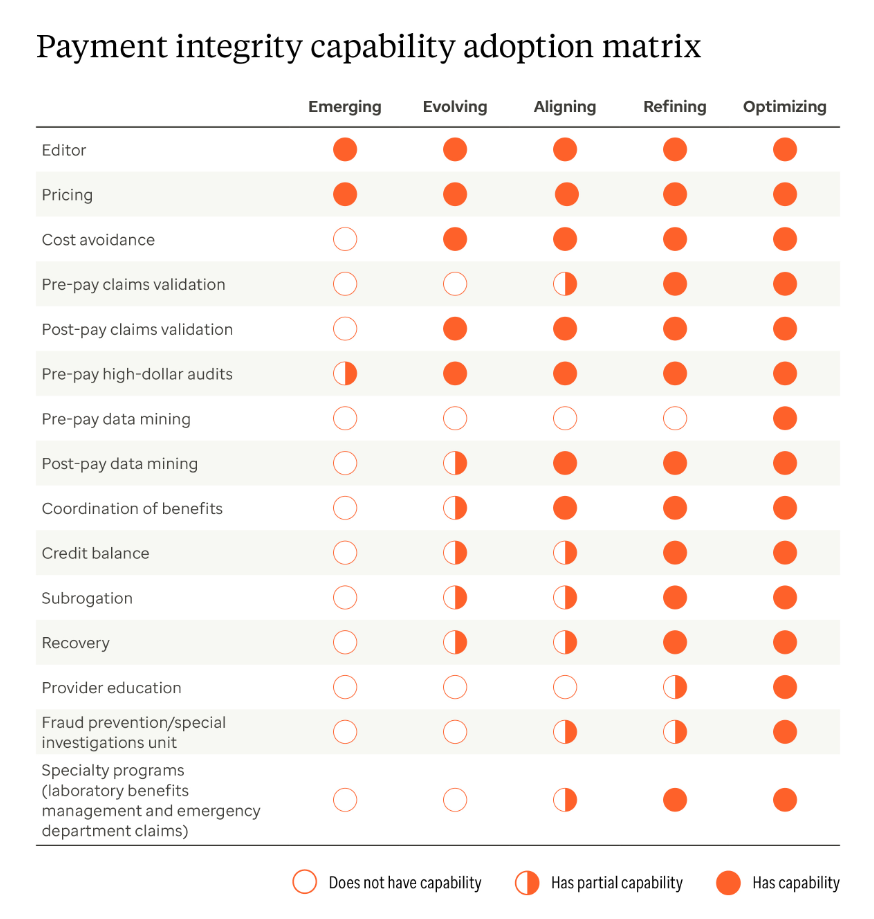
Capability adoption matrix

An initial way payment integrity program maturity can be distinguished is by the capabilities health plans offer today. This matrix breaks it down by each of the 5 maturity levels.

Continue reading to see which level of maturity best describes your payment integrity program and gain valuable tips on how to level up.

Level 1: Emerging

Payment integrity programs at an emerging level tend to be highly fragmented, with siloed work units. As a result, they may demonstrate a lack of focus and clear outcomes. These programs also tend to be reactive instead of proactive in dealing with increases in medical spend trends.

Emerging level payment integrity programs are just beginning to develop their strategy. This lack of maturity manifests in a reliance on post-payment audits and recovery, with limited to no pre-payment activities.

Tips for programs at the emerging level:

  • Complete a gap assessment of current payment integrity capabilities that compares with those of a mature organization.
  • Partner with other teams in the organization who are addressing health care affordability to align payment integrity programs to financial outcomes.
  • Identify payment integrity champions in your organization to align pre- and post-pay functions to an executive sponsor.

Level 2: Evolving

Payment integrity programs at the evolving level have realized the benefits of post-pay strategies for payment integrity and are starting to consider pre-pay programs that require low technical lift.

Organizationally, programs that are evolving tend to be fragmented across different teams. Operational processes are usually highly reactive, and payment integrity is not fully adopted across all lines of business.

Tips for programs at the evolving level:

  • Organizationally, consider consolidating payment integrity processes and functions under a single accountable leader with clear goals and financial outcomes.
  • Evaluate existing post-pay functions and consider which ones can be shifted left to pre-pay, partnering closely with operations and technology teams.

Level 3: Aligning

In the aligning level, payment integrity is becoming more of a strategic focus for the health plan, even if it does not roll up to a single accountable leader. They’re starting to set clear financial goals and establish governance to track performance and outcomes.

Another key characteristic of programs at the aligning level is a shift toward high-yield programs implemented across all payment integrity disciplines. Covering both pre- and post-payment, these programs may include a mix of internal functions and vendor-supported services.

Tips for programs at the aligning level:

  • Designate a centralized leader for payment integrity.
  • Begin establishing a payment integrity office (PIO) to oversee all payment integrity operations.
  • Focus on lagging areas, such as payment integrity goal setting and governance.
  • Start thinking about adopting more pre-pay capabilities to achieve greater savings and shift appropriate post-pay activities left.

Level 4: Refining

Programs at the refining level are beginning to show clear signs of maturity in payment integrity operations. This maturity is best exemplified by the establishment of a payment integrity office to oversee operations, promote best practices, set performance metrics and provide leadership.

With the PIO in place, these programs will begin to formalize payment integrity processes. As a result, these health plans will have begun to adopt the most current pre- and post-payment capabilities to drive maximized results. Programs at the refining level are well on their way to full maturity.

Tips for programs at the refining level:

  • Finish the processes of developing best practices, formalizing a governance model and standardizing payment integrity throughout the health plan.
  • If the health plan is still missing any key payment integrity capabilities, now is the time to address those gaps.
  • Ensure that payment integrity savings targets are directly aligned with the organization’s overall financial objectives, working closely with actuaries to validate assumptions and ensure accuracy.

Level 5: Optimizing

At the optimizing level, programs have reached the highest level of maturity in their payment integrity function. These health plans have payment integrity programs that are orchestrated across pre-pay, post-pay, SIU and other internal and external programs.

There is a clear and accountable owner for payment integrity, rolling up to the COO or CFO, and financial goals are tied to organizational goals. The PIO is proactive in managing internal payment integrity teams as well as vendors who support the broader payment integrity function.

These health plans are continuously looking to optimize payment integrity functions to tap into more savings and operational efficiencies. Optimized payment integrity programs have a balance of internal ideation teams and strategic partners that drive value for the health plan.

Tips for programs at the optimizing level:

  • Focus on maintaining established processes and look for incremental improvements that could increase efficiency and results.
  • Pay close attention to metrics to identify trends or weaknesses.
  • Drive innovation in the payment integrity space by encouraging new ideas.

Related healthcare insights

Beyond Payment Integrity: An AI-Driven Approach to Affordability

Article

Beyond payment integrity: An AI-driven approach to affordability

Medical costs are rising, and health plans need solutions. See how an AI-driven, enterprise-wide approach may be the key to affordability.

5 AI Use Cases in Payment Integrity [White Paper]

White paper

5 AI use cases in payment integrity

A strategic blueprint to modernize your payment integrity program through intelligent, AI-driven health plan operations.

The New AI Approach to Eliminating Contract-Based Errors

Article

The new AI approach to eliminating contract-based errors

Learn how we're leveraging AI to help minimize payment errors associated with manual contract reviews.