Marsha Martin: Okay. It's right at 3:30, so I think we're going to go ahead and get started. Before we get started, I just want to say thank you for being in this session and for participating with us. We're glad to have you. We're going to do a deep dive into Arkansas Independent Assessment. I'm Marsha Martin. I'm part of the Optum BPO team and with me, I have Jennifer Peterson.
Jennifer Peters...: Hi, everybody. Thank you for joining us today. I'll just give you a quick little intro. My background is I'm a nurse practitioner by trade, but by profession, I'm now the director for, and have been since 2017, the Arkansas Independent Assessment Program. And so we're really glad to be able to share the transformation activities that we've done within Arkansas.
It's my ultimate pleasure to introduce Paula Stone, and I'm going to let her tell you a little bit. Paula is our partner with Arkansas. She is with DHS and just a pleasure to have her here to share the experience of what we've done in Arkansas from the client perspective. Paula?
Paula Stone: Good afternoon. Thank you for attending this 3:30 session. I'm Paula Stone. I'm with the Department of Human Services in Arkansas. And in Arkansas, the Department of Human Services is the Medicaid entity, but it's also the entity for specialty populations, so behavioral health, aging, intellectual and developmental disabilities. Each of those have a division and we have multiple funding that comes into those divisions, but we're also responsible for the Medicaid services for those individuals.
We also have child welfare and juvenile justice in our DHS. So, I am the director of the Office of Substance Abuse and Mental Health, which is the mental health and substance abuse. And we also run our Arkansas State Hospital as well, which is an adult facility. It's a state run adult facility.
And now, probably as of the last couple of months, we're about 99% forensic. So, everyone who's coming to our state hospital, over 200 adults, all are there related to a crime that they've committed and been found unfit to proceed.
Jennifer Peters...: And we'll talk more about that later. So, I'll go ahead and get started with our agenda if we can. We're going to look at the background and the history of how we got to where we are now in 2026. Started this journey in 2017 and we'll be able to share a little perspective with you of that journey. Talk a little bit about the assessment tool, and then also the platform and support that it takes to actually pull this all off.
Paula Stone: So, this is a little bit about the population. I alluded to those three populations and it is those with high needs. So, I think you all would recognize those as those who need home and community based services. This is the population that we're assessing.
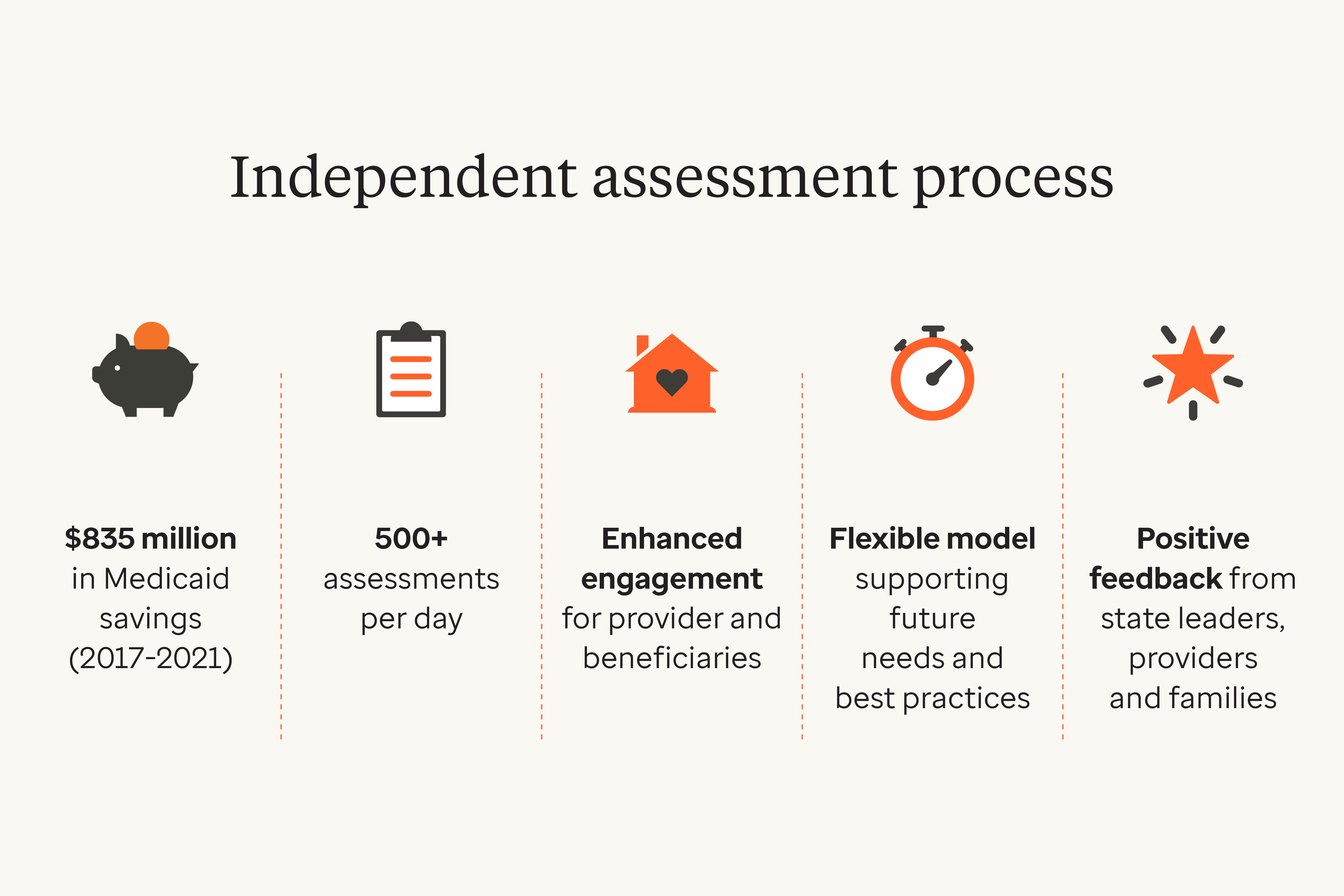
Our goal was to save $835 million in five years, and we looked at our data and found that our data showed us that most of our expenditures, and I'm sure that's the same for all states, 80% of the Medicaid expenditures are always with about 20% of the population. And these are high needs populations.
So, not only are they high expenditures, they have very high needs. So, you can see the volumes of assessments that need to be done. This one slide just shows the behavioral health assessments that we're doing, 66,000 a year.
Marsha Martin: Next slide.
Paula Stone: So, just a little more about that healthcare task force. I think it was back in 2014. I see our former Medicaid Director in the audience. It was a little before 2013. 2012. So, I was definitely in another role at that time. We had a new governor, Asa Hutchinson, at the time and there was a lot of concern.
This was the second time we had said, "We're going off a cliff in Medicaid. We're not going to have enough state general revenue to pay our match and we are going off a cliff. We have to have a plan for this." And so he created a legislative task force. Different people brought different solutions to the table, as you would see done in most states. And so really looked at how can we save this money, keep ourselves from going off a cliff, but also looking at the future?
And so thinking about, again, all of those people with the needs for home and community-based services. One of the things we realized on the behavioral health side was when you came in the front door at Medicaid and you needed a behavioral health service, somebody could give you a diagnosis and you could get a full array of services.
Now, back then, we did not call them home and community based-services, but we were using a different vehicle, different Medicaid vehicle, allowing people to get services from paraprofessionals, which very much looked like home and community-based services.
And so knowing that was that that front door was wide open and the providers were able to say, "Yes. This person needs this full array of services." One of the things that naturally happened was if you have somebody that's in your office and you offer a menu of services that include professional services like counseling, outpatient counseling, individual counseling, group counseling, family counseling. But you also can offer services that are delivered by a paraprofessional that are rather broad, then you're probably going to offer those services to the people who come to see you, right?
The people who keep coming back, not as much the people who maybe have the high needs. Because in the behavioral health world, people with high needs aren't really readily available. They don't keep appointments as well. They don't come to your office. If they come to your office, they may not come back to your office and that's what we were showing.
And so where do they end up if they don't come back to your office? They end up in the emergency room. They end up in psychiatric hospitals, they end up in a psychiatric unit in a hospital, they leave and then they come back again.
So, we saw that cycle and then we saw a lot of the people that were being treated were those people that were the easiest to treat, the ones that didn't have quite that many difficulties. And so really looked at making sure that we said, "Okay. We're dividing these out into two different populations."
We know that there are 100,000 people getting, maybe more like 120,000 people getting a behavioral health service. We know that really only about a quarter of those need these intensive home and community-based services and need them desperately. So, what we were doing was to target those services and create that way to get them those services that they needed.
Jennifer Peters...: So, that drove them to partner with Optum to create an assessment tool that would serve all of their different divisions; adult and aging, behavioral health and DD. The same tool where they could configure the logic and the tiers and the tool to serve all three populations.
That was the challenge that they brought to us, and we decided to go ahead and present to them a tool that was in the public domain, the MnCHOICES out of Minnesota. So, we took MnCHOICES and we brought it back to them and we spent a lot of time looking at the tool, looking at what we could collect, and how to configure the logic for each of the different divisions and how to configure the assessment to support all divisions. And I'll let you talk a little bit about that process.
Paula Stone: Yeah. And I'll be really honest. So, when we had someone new that came in as our Medicaid Director and we had some individuals that came through, I remember being pulled into the office, and it was me and the director of the division of adult and aging and the director of DD, and the person said, "Do y'all want to do this separately or you just want to do it together?"
We all looked at each other and it was late on a Thursday afternoon, and we all were like, "I guess we'll do it together," not knowing what we were getting ourselves into. And so we wrote the bid, we put the RFP out for all three populations at once, and we said, "Bring your own tool." And so we didn't really expect that we would have a single tool that would fit all populations.
In fact, when I saw the tool that was being proposed by Optum, I said, "I'm against this. I'm 100% against this. I don't believe that this is what's going to work." And so we had them come and do a demonstration of the tool.
I got staff members to pose and write a script, which they loved because they got to act as people with mental health conditions. Either the mom of somebody with mental health conditions or a mental health condition themselves. And we put Optum through the test of saying, "Okay. You interview this person, you do it in front of us."
And then they went back to their hotel overnight and came back with the tier results. We had written what we thought would be the right response, what we voted on internally and I thought, "We're going to get them and we're not going to give them this contract."
They came back with the tier results. I was in shock, I kept thinking, "I'm very scared about this," because the MnCHOICES is an instrument that was developed for elderly people, long-term services supports. And I said, "How could this translate to seriously emotionally disturbed children? I just don't see how this is going to work."
And so once it got going and we developed the tool, we really realized, and I as a clinician, realized it's a functional assessment and the level of functionality is very different than a clinical tool. So, all of those other assessments that were built out there for behavioral health specific or more clinical tools.
And so I had to then go out and defend this to the providers that I was mentioning, who had that ability to somebody to walk in their door and them to say, "You get all these services." So, the providers were none too pleased that we were going to say, "There's a bump in the road now, where you don't get to decide that."
So, the immediate response from them was, "Clinically, no. How dare they? How can somebody come in and tell me what my client needs when I know the clinical piece of this?" So, being a clinician and having the same doubts myself, I was able to go back and say, "It's very different. There's a difference between your diagnosis and nobody is going to change that diagnosis. Nobody is going to override your diagnosis."
I did not say your diagnosis changes. If you're in the behavioral health world, you know how quickly a diagnosis can change from week to week. I did not say that because I was being nice, and wanting to sell this product, really believed in it.
And so we said, "Okay. It's a functional assessment." So, we used those words over and over and over and over and use them to this day. So, we've been using those for the past 10 years of you can have a diagnostic assessment and it really ended up being the same thing, which I did not expect on the IDD side.
There's an IDD diagnosis, but your diagnosis is one thing. How it affects your ability to function, your day-to-day functions is a very different thing. And that's really the threshold for needing home and community-based services. I used to say everybody probably in the room could have a behavioral health diagnosis.
I used to say, "I'll give you all a behavioral health diagnosis. I probably have already done it in my head as we've all been sitting here, but I don't know your functional ability." And so really want to make sure that we get that right.
So, that is one things that we did and that came full circle for me of we didn't know what we were doing. I don't know how many of you are state employees out there, but I don't know how many times we walk into something and have no idea what we're really getting ourselves into or no idea what we're doing.
And then you just try to make it work, and what's really important of making it work is a partnership of being able to say with your vendor, with your partner to say, "Okay. We've got to make this work. It's what we need for our populations that we serve, what we need for the people that are beneficiaries, and also what we need for our finances."
Jennifer Peters...: Just a couple of things I'll add. The one thing that I think really came that we focused on was giving that beneficiary a voice. Now, the caregivers, the family members, the caregivers, the beneficiary finally had a voice in what the functional assessment needed to tell about them, and what they needed to live a really strong quality life. And I think that's been a great benefit.
Paula Stone: It has. I don't know if you want to tell them about the fact that how many people with suicidality that you identified, because it was a very different approach. You were in their homes. I don't know if we talked about that. All of these assessments were done not in an office, in a home.
Jennifer Peters...: Face to face with the beneficiary. A surprising positive consequence that came out of it, and something we had to actually train our assessors for, was these assessments can be triggering for behavioral health for all clients. There were times where we had to actively help support that client in their home. I'm sure there's no real concrete way we can say that we save lives, but I know that there's lives that were saved because we were actually there.
There was something that was going on with that client that may never have been caught anywhere else and we were able to link them with services. And then just as we get into it, we'll talk about the managed care that our assessment feeds into the care coordination, I think has just really been impactful for these beneficiaries in Arkansas.
But so who receives an independent assessment? We've talked about the three divisions; the adult and aging, the behavioral health and the DD, and they all have just a little different nuance. The adult and aging is completed by a registered nurse, an RN. And then our behavioral health and our DD are completed by what we call a community health worker. This is an assessor that has some specific experience and training with that population.
So, if they're a BH, then they've had some behavioral health background working with those clients. Actually, as we kept doing this year after year, a lot of our BH then were trained to do DD or our DD began to do BH, because we do see a lot of overlap of both. Which actually then resulted in even a broader complex where we did a complex care addition to it. I don't know if you want to speak a little bit about our complex care.
Paula Stone: Yeah. So, when you work with a partner for as many years as we've worked together, you really lay that foundation. Now, a lot of that foundation was laid with blood, sweat, and tears and a lot of pain, because there was a lot of pushback from providers in not trusting. But we had to, particularly at the outset, we had to get the providers are the ones who identify the clients in these populations.
Those beneficiaries don't often answer the phone. They may not respond to a call center. So, really getting that provider buy-in and building that relationship out there. And having those providers identify those individuals and then as well help them to receive those services, and then developing that trust with the assessors. That was a lot of things that we thought about was, since it's a functional assessment, we don't want professionals.
We don't want mental health professionals to go in. While we're using nurses on the aging side, we don't want mental health professionals in. And so really making sure that we develop that relationship and how that tool was delivered. Particularly, if you were either sharing space, or going into someone's home, or you were going into an office of really making sure for each of those populations that we had the right person there.
I think a lot of work was done around the training of those individuals. And then we had a lot of appeals at the beginning. So, really making sure that they were prepared to go in if there was an appeal being able to provide that level of testimony to say that this was done correctly.
And then I think just the high level, Jennifer and I talked about it at the beginning, of if there is a result that does not allow them to get a home and community-based service on the behavioral health side, of just doing a review of all of those from the very outset instead of waiting for somebody to complain about it.
So, then I could say to anybody who's asking a question, "Those have been 100% reviewed. This is the review that's going on behind the scenes. This is how we know it's working." And if anybody ever called, a beneficiary called or a family member called and said, "I didn't say that. I don't think they took my words as I said it," then we would just do another one, even though that was difficult. So, really looked at, again, building that trust in the community with both providers and for beneficiaries.
Marsha Martin: Next slide.
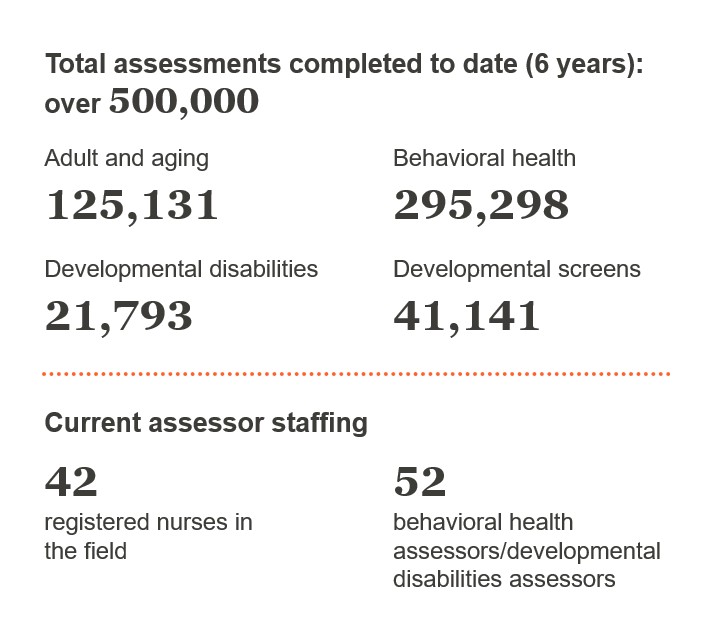
Jennifer Peters...: So, this is just a little bit of our data to talk about the assessments that we've done at the end of six years. We're now into our seventh year, getting ready to go into our eighth year. A lot of assessments that have been done. A little bit about our staffing, like I mentioned, we have registered nurses and we have our community health workers that complete this.
Marsha Martin: Before we go on to the next slide, I'll pause here. Are there any questions from anybody? We're going to start to talk about the process a little bit more so I thought I'd pause and ask. Okay.
Paula Stone: I saw this slide when I got here. 300,000 behavioral health assessments, it's 300,000 times where we've had an individual go out and face-to-face do that assessment with someone. That's powerful. I would have never thought that we would be able to do that level of assessment, and thinking about on the front end, just trying to get all those people who are currently receiving services assessed.
And so just making sure that happened, particularly in Arkansas where it's a rural state of being able to recruit. We were talking about this as well is that while Optum is not located in Arkansas, all of their Arkansas work is done in Arkansas. So, there's been so much recruitment that's happened, so many people who have been trained.
And then people going out into those communities, willing to go out to those communities and willing to go out into those homes, which sometimes is challenging to do that many assessments.
It requires so much coordination and coordination that we would have, as a state, never been able to do internally hiring all those people. Other states have used other tools for their home and community-based services. Maybe something where you're reviewing at the desk level and coming through and having someone go back through. It's just what we decided in Arkansas was not to do that level of review, that we really wanted to make sure we had eyes on those individuals.
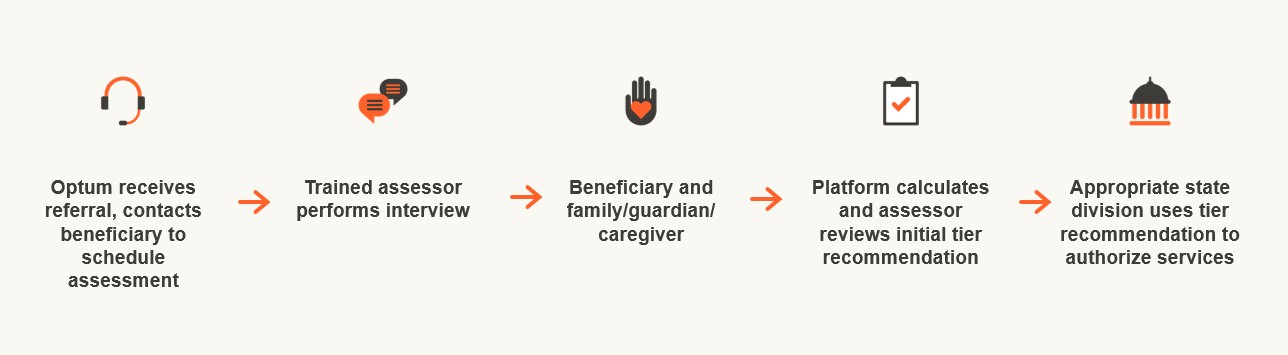
Jennifer Peters...: So, a little bit about our process. We receive referrals in multiple different ways and I won't go into big details, but we get referrals in, we process them. We have a call center. The call center we've evolved into having some real experts. We have experts in the adult and aging part. We have experts in the DD part. We have experts in the behavioral health part, because they all have a little bit of their own nuances.
So, we get those referrals. They get handed off within the system. We have different skill sets. So, not only do you have one type of referral, but you have a skillset that's attached to that and that's in a specific region. So, there's a lot of pieces that you have to connect in order to get the right person at the right time with the right skillset.
And then we also make sure there's different populations that we have specific monitors that need to be the 911 population. We have monitors that need to be involved in the assessment. We need to make sure in certain instances, if there's an adult and aging beneficiary that has dementia, that they have a caregiver that's there with them.
So, there's a lot of little nuances that we've worked through and know where we have to have success. So, it's getting all the right people in the room at the right time. And then we do the assessment. For behavioral health, it's about a 50-minute assessment.
Adult and aging, it's longer because we're going through IADLs and ADLs and it's just a little more intensive. That can be up to about an hour and a half to hour and 45 minutes.
And then the platform works through the logic that we, DHS and Optum, work through to develop. And then we share that and that's part of their process for assigning services. Each of the different divisions has a little bit of different process and how the assessment plays into it and where it goes from there.
I'll give you just a little tweak in here on the domains and the independent assessment activities of daily living. Caregiver domain, which is really important for the DD population. Employment, health, instrumental ADLs, very important for your adult and aging. And then of course your psychosocial domain, which is very important for our behavioral health. So, these are the different domains in the assessment, and we'll show you a quick view of the tool when we get to that too, if we can.
Paula Stone: We had some at the beginning also with that psychosocial domain or all the ADLs, particularly with our adults who have a diagnosis of schizophrenia that we had to work through, because adults with a diagnosis of schizophrenia may be answering questions from a perspective.
So, I would get calls from the providers that would say, "Well, he didn't score out correctly on your independent assessment, because he believes he's a ninja and ninjas can do everything. They do everything well." There's no question on the assessment that says, "Do you think you're a ninja?" Because again, I said it's not a diagnostic assessment.
And so there were several people that had some delusions and so we were not getting the questions answered correctly. It's supposed to be an independent assessment, so we worked through that. Allowing providers to come in and also support people that are having some real active issues with their mental health, making sure that we're getting all of those questions answered accurately. And being able to say, "Okay. If they're not being answered accurately, we're getting some additional information from another source."
Jennifer Peters...: Like in our state hospital we do include a social worker or coordinator with our assessments, with all the state beneficiaries that are there just as the checks and balances. And then we had training that we did with them, so that they understood what the purpose of the independent assessment was, that it was a functional assessment.
Again, that was always really important that this isn't a medical assessment, this is a functional assessment. This is just a brief look at what the psychosocial domain looks like.
And then the next slide is just a brief look at the ADL domain. These are two parts of the assessment that are just so critical. The way we do our training with our assessors is we actually have case studies that they do. As they're going through and they do their case studies, their simulations, there's certain expected results and that helps us to do checks and balances with them through the course of the whole year, improve our quality.
We use those simulations as part of our peer review process with assessors. It's just been very successful in standardized application of an assessment tool, which is always your challenge.
All righty. I don't know, Paula, if you want to talk a little bit about tier development, particularly for behavioral health.
Paula Stone: Yeah. So, we use this for a number of different purposes. So, for the behavioral health population, we have 1915(i) services, which is a waiver-like home and community-based service program. CMS does require an independent assessment for that. So, this serves as the required independent assessment for our behavioral health population.
It's also we use it to develop the person-centered service plan. We also use it because not only did we want a 1915(i) launch the independent assessment, then that population is going into a managed care situation. So, we combined both the IDD population and behavioral health population, and the behavioral health population that needs home and community-based services.
So, seriously mentally ill or seriously emotionally disturbed, which are federal designations. The rule on that federal designation is it's your age, it's your diagnosis and it's a functional assessment. So, now we've been able to say this one tool gives us the SMI SED designation. It meets our needs for the independent annual assessment. They have to be reassessed annually for the behavioral health population for them to be able to get 1915(i) services.
And then it also sets the capitated rate for those populations because we have them tiered that go into our managed care program. So, it's serving all different kinds of purposes. Then that person-centered service plan is developed, that's also required for the 1915(i), is developed based on clinical history and then the results of the independent assessment. So, it gives them that place to do that.
For our DD population, it is not used in the same way, but you have to use it to go into our managed care program. So, it really helps us a lot to be able to track in our MMIS system to say, "Do we know which door they came through to go into our managed care system? Do we know what their assessment was? When did they last get their assessment?"
So, all of those pieces are part of what we're using this for. So, multiple levels that we use. So, again, back to our very beginning, we set this out to control some cost and it does that, but then it gave us more than that. It's giving us that ability to meet those CMS requirements and to build our plans to serve people.
Jennifer Peters...: I'm going to let Paula talk a little bit about the PASSE system because she's the expert.
Paula Stone: Yeah. So, the managed care system is called the Provider-led Arkansas Shared Savings Entity, which autocorrects as PASSE. We should have very carefully, I would always say that to other states, is please make sure that when you do an acronym, that you put it on paper and that you vet it with everyone, because you will be mocked mercilessly for 10 years.
People just obviously who don't just come up and say, "Well, that PASSE system is not working." Well, okay, we understand. So, that was our first foray. It's Arkansas's only managed care system and so we started out by specialty populations.
So, we went at it the opposite direction than most other states. Most other states start out with a broader population, do a carve out. So, our managed care companies, they get their individuals based on, for the behavioral health side, the assessments.
They also have to do reassessments. So, once they get into that program, they get care coordination. When we first started this, when the managed care companies or the PASSEs said, "Well, you should be pursuing our beneficiaries, our members to get these reassessments." And we said, "But you have a care coordinator now."
So, on the front end of this, when they're newly identified, Optum is chasing them, Optum is pursuing them, Optum is making sure. So, we at first, said, "We're not getting really good results if the care coordinators call themselves and schedule the reassessment." So, we had said, Jennifer and I said, "No, we're not going to do that."
But through the years we've really worked through the system instead of doing phone calls, that care coordinators are able to actually... So, Optum built a system where care coordinators are actually able to go in and schedule appointments for their clients, and I think we're seeing a lot of difference.
So, it's again back to you build a foundation and then you have some aspirations, and then you just are able to layer on. I think that that's finally where we're at this stage where those reassessments. Because 66,000 new assessments and reassessments every year is so much to keep up with. If people do not get that reassessment then they are moved back into the Medicaid general population and they don't have access to home and community-based services.
Still access to counseling and every other service, but not home and community-based services. So, it's really important that we have that investment in making sure those reassessments happen annually.
Jennifer Peters...: I would say that the partnership with the providers has just grown and now we have the largest populations. They're calling in and saying, "Hey, here's my group. Let's get them scheduled." So, now we have a proactive approach for getting reassessments too, which is really great.
All right. I just wanted to touch a bit on the flexibility and being agile and flexible. We all know COVID happened. It's a little bit of PTSD for all of us and when that occurred, it was like, "Oh my goodness, what are we going to do? We've been doing these face-to-face. How are we going to pivot? How are we going to make this happen?"
Collaborating with DHS, we were able to pivot to start using a virtual telehealth platform. It was quick. We did it over a course of about two weeks. There was some training that we had to do with assessors. We did some quality assurance. We did 100% quality assurance. It took a whole bunch just to see if we're going to get the same results.
It was a success story, and I think that helped us to look at using some virtual health for some going forward, which we did for some reassessments and renewals, and it remains a very viable solution. Beneficiaries get their choice whether they want to be seen in person, because there are some beneficiaries and caregivers and families that want that, and there's some that are very supportive of using a virtual platform.
All right. So, we're going to go on to slide 16 here, where we're going to talk a little bit now get into the technology part, the platform. We did use a commercial off-the-shelf platform and then we built on there.
Reporting was very important and something that was critical to making this work, just from the fact that we had to understand how to manage schedules, how to manage assessors, how to manage results, how to look at referrals to see where we are with scheduling, with referral completion. Just the reporting really drove the operation.
So, reporting was critical and it was critical also strategically for DHS, so that they could make plans. I'm just going to show you a quick demo that runs through some of the reporting that we do that helps to drive day-to-day-
VIDEO: ARIA reporting. In this demo, we will walk you through the powerful reporting capabilities available in the ARIA system, which helps supervisors, assessors, and quality teams continuously monitor program performance and operational efficiency.
ARIA's supervisory dashboards compiled data by work type or division, giving leaders an instant view of compliance metrics such as the status of today's appointments, including in progress, cannot complete, and interview completed, along with totals of appointments completed over the last seven days. Appointments that could not be completed today or yesterday. And the number of upcoming appointments that are due, but not yet scheduled within 30 or 60 days.
The dashboard also highlights upcoming workload for the next seven days. Appointments scheduled beyond service level agreements, referrals that have been moved to close status with due dates in the next 60 days, and operational issues such as long drive times. Appointments needing an assigned assessor and service appointments requiring status review.
ARIA includes an assessor call confirmation status dashboard, which allows supervisors to track future appointment call confirmations to ensure alignment with required program metrics. Along with trend reports showing how many appointments could not be completed today, within the last seven days, or within the last 30 days by each assessor, allowing comparison across similar skillsets.
Additional operational views help teams monitor assessments that are still open or are not completed. For quality oversight, ARIA provides quality assurance dashboards that report when questions were incorrectly populated or selected based on assessment type, age, or gender. Along with summaries of why appointments were not completed in the last 30 days, and how many needed to be rescheduled due to beneficiary related or Optum related reasons.
The system also offers visibility into client satisfaction survey comments and allows QA teams to audit outcomes filtered by time period, skill, or audit result. ARIA even auto generates a monthly list of randomly selected assessments. 4% of all assessments completed in the previous month to support QA sampling, trend errors for training, and ensure consistent quality across assessors.
Beyond dashboards, ARIA provides customized reports including assessment completion time trends across assessors, regions and work types. Emergency contacts reporting used for business continuity validated through each worker's personal update link, PTO trends, referrals filtered by location to understand regional workload. Tiering outcomes by assessor to analyze result distribution, and reporting on appointments impacted by inclement weather for either beneficiary or assessor.
All together, ARIA's reporting environment delivers a comprehensive and actionable view of performance, quality, and operational health, ensuring teams stay compliant, proactive, and well-informed across every stage of the workflow.
Jennifer Peters...: So, you can see it's pretty complex in order to get everything to happen at the right time, right place with the right assessor. The next slide here is just a slide of some of the key IT platform capabilities, which you saw with that.
Our intake, our scheduling, getting the assessment completed, doing the tier determinations. We have an appeals module that we monitor and overall, there's less than a 0.5% appeal rate across the whole program. So, very few appeals compared to when we initially started back in 2017.
How we do our outreach from the call center, all the reporting. And then quality assurance, which we're going to show you a little bit about our smart audit tool here in a minute.
Paula Stone: One of the critical things for our state, I think, and important with this was there was a lot of concern from providers, from legislators that this would prevent people from getting services they needed. And so there would be reports that would come in pretty consistently that they didn't call back, or they tried to schedule appointment and they couldn't get an appointment scheduled, or they were given the wrong tier.
And so having those reports at our fingertips of being able to say, "This is where people are in this status, that we have this many calls that have gone out. They've been pursued. They've answered their phone. They've scheduled an appointment and they didn't keep an appointment." So, there are several different points in time in which that could not happen.
Somebody didn't either schedule appointment or they didn't make the appointment. And so we had to show that we were giving people every opportunity to come get this assessment. Every single opportunity. Not that we just waited for them to call us, that Optum went out and called them and tried to schedule an appointment. And then if they didn't keep their appointment, how many people didn't keep their appointment? And then how many people kept their appointment after that?
Thinking about those timelines with a reassessment, you have to get that annually. You had to back that up and say, "Okay. When do we start calling people to make sure that their assessments?" So, making sure that those people were pursued.
That reporting became really critical for us as a state to make sure that everyone knew where people were in the process. And if there was an issue with people not returning phone calls or not showing up to appointments, that we were really able to say that.
Jennifer Peters...: All right. A little bit about the contact center. I'm going to let you take that.
Marsha Martin: Here we have a video first.
Jennifer Peters...: Oh, sorry. We have a quick slide. All right. Oh, this is ARIA care coordinating portal schedule.
VIDEO: ARIA care coordinator portal scheduling. Hello, everyone. Today, we are going to share information regarding the care coordinator portal and how it's used to reserve scheduling slots for a program, provider, agency, or identity that we want to authorize for direct scheduling access for clients who have active referrals with Optum.
The concept of this portal is to reserve appointment availability by creating a resource absence, which tells the scheduling system that the assessor is no longer available for standard call center automated scheduling. It also creates a visual block on the assessor's schedule to show that the time is reserved and identifies who will schedule the appointments for that date.
To create the reserved scheduling slots, you first determine the assessor and date. Open the assessor's profile and select absences, then select new, choose non-availability and continue. Next, select the checkbox for care coordinator scheduling portal and choose the correct program, provider, agency identity from the MCO provider pick list.
Set the type as non-available. Then enter the start time and end time for the date and timeframe you want available for portal scheduling and in the Gantt label, enter the information you want visible on the header of the scheduling block, then save. This creates portal scheduling slots for the selected program, provider, agency, identity, and prevents others from scheduling during that timeframe.
You can also color code the blocks by entering specific Gantt label color codes to make them easier to identify on the schedule. Once an appointment is scheduled through the portal, it becomes visible on the assessor's schedule.
Today, we typically create 3:00 AM and 3:00 PM video appointment slots with a duration of one hour and 15 minutes each for every care coordinator portal scheduling block, but this can be customized based on the number of slots, slot duration and start times.
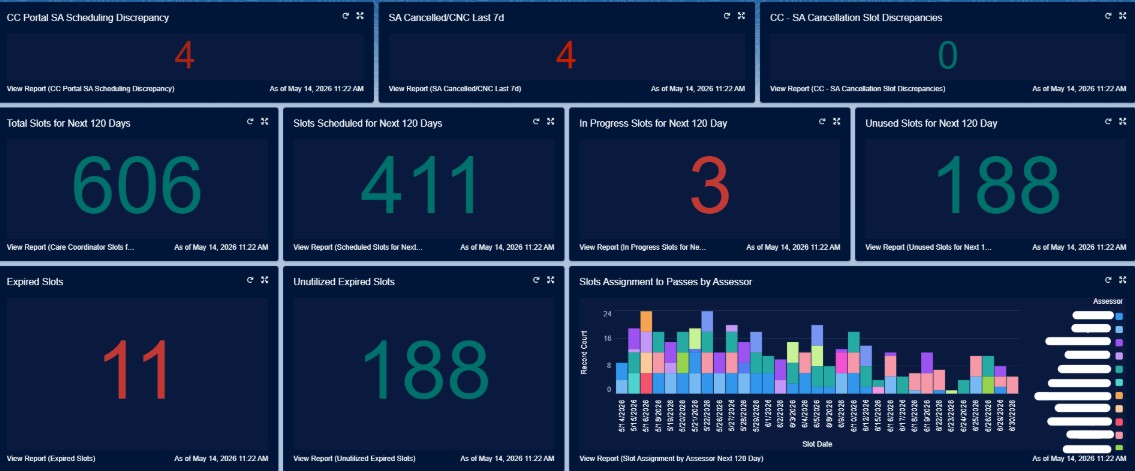
Finally, a care coordinator portal dashboard is available with reporting that provides both high level and detailed visibility, including the number of slots created, how many have been filled, how many remain available, how many expired unfilled, which assessors have slots assigned, and how many appointments were completed versus not completed.
Jennifer Peters...: This has been important because Paula spoke about the PASSE system and care coordinators. Now, the care coordinators can actually pull these reports and they can see from their own group who they have challenges with scheduling. It brings some of the ownership, like Paula was saying, back to the PASSE to get these completed and that's been really helpful also. This was an enhancement that came about in the last 18 months.
Marsha Martin: The next slide is about the contact center. I just want to pause here and say that the focus of the call center was about putting the beneficiary at the first and foremost, whether it was the technology solution or the operations. We needed to communicate with these folks. We needed them to be comfortable with us, with the technology, and all of the solutioning from there on in.
So, an example that Jennifer gave earlier was the video conference calling. I think that was a great asset in the program itself. It allowed people to be able to be available via video. Some people feel safer not having an assessor come directly to their home, so if they qualified a video conference was a good fit for them. It also helped us solution some of the travel time and that sort of thing for the assessors, so it was a benefit that way as well.
From the technology, we do inbound and outbound. We coordinate between the referrals that come in and also the reassessments that need to be done in a timely manner that Paula was talking about. So, we get the annual assessments done and understand what the timing needs to happen there and do the timely follow-up.
All of the technology is easy for beneficiaries to use and navigate. I think that's also important from facilitating good communication and having them feel comfortable.
And then finally, on the contact center staff itself, they are trained to understand what the beneficiaries need. Trained to communicate effectively. Trained to understand if maybe that person is having an emergency and what to do. And demonstrate some empathy and understanding, which is really important for this population.
I think that that helps people feel a little bit more comfortable with calling in and actually taking the time to schedule the assessment and follow through with the program.
Jennifer Peters...: Thanks, Marsha. Our next slide, it's a busy one, but I think what you can take away is in the middle there, the Arkansas Independent Assessment System. The portal or the platform actually supports the assessment work, the scheduling, referral and beneficiary data, provider data, appeals.
At one time, we were also doing some screens for the state, so that was there to outreach, reporting. So, it is all one huge system that can pull everything together for the state that they need, and it shows you there's multiple intakes and multiple outputs.
We do have integration layers that sends information back to the state, which then they update MMIS with. We also work with a couple other vendors that use our information. I think with that we could go to a little bit, we'll just show you a little demo here.
VIDEO: ARIA quality assurance and smart audit demo. The ARIA program at Optum uses a comprehensive quality assurance framework design to ensure every assessment is accurate, consistent, and continuously improving. This framework begins with preventative measures built directly into the assessment workflow, including required questions that must be completed before submission, dynamic question hiding that displays only relevant content, and logic that identifies contradictory selections and prompts assessors to correct them.
After submission, smart audit capabilities provide automated data driven validation by flagging potential errors, evaluating whether issues impact the final outcome, routing assessments back to assessors for revisions when needed, and trending audit results over time to identify recurring patterns or systemic gaps.
Drill down analytics enable detailed insights from program level views down to individual assessor performance. Beyond audits, ARIA incorporates real world feedback from appeals, complaints and client satisfaction surveys to identify areas for refinement and ensure assessment clarity, accuracy and user confidence.
All of these inputs feed into ongoing training and continuous improvement efforts, informing targeted coaching, refresher sessions, updated guardrails and logic, and enhancements to processes and governance. Together, these elements create a robust end-to-end quality ecosystem that strengthens assessment reliability and drives ongoing excellence.
Jennifer Peters...: And then if we could just go into the-
Marsha Martin: Sure.
Jennifer Peters...: I'm just going to show you quick what the platform looks like so you have a chance, and we won't spend a whole lot of time here. You can just see. So, this is actually a beneficiary file. If you can page up a little bit, Marsha, we'll start.
Marsha Martin: I'll start at the top.
Jennifer Peters...: So, this is a beneficiary file, and I'm actually showing it to you in the classic version because I know, we'll assume it's not here anymore. This is our classic version. This is how our customers or our client sees it, the state users. So, when they can go in, then they can see the beneficiary file, and all this information we can configure to fit the population that we're serving and what they need to see as far as demographics go.
It has location and mapping and this is all helpful for the assessor as they go to visit and complete the assessment. Within the beneficiary file we'll see any assessments that have been completed, we can go back now some beneficiaries have six or seven assessments on their file.
We can see any trends where they may have gone from one tier to another tier. Maybe they started out in behavioral health and ended up in the DD division. We do see that happen occasionally. And then we can actually go in, and if you'd click on that assessment number, we'll just take a quick look at what an assessment looks like.
This is where we track all the referrals, and then when the assessment's completed, we have the ability on the top to retrigger results being sent. We can create PDFs. There's things that have been determined that are needed in the course of the past six, seven, eight years. Now, occasionally someone will need a PDF. We can create that and the user, the DHS user can go ahead and access that through the platform.
If you page down we can see what the completed assessment looks like, the different domains, the actual scoring of the assessment and what triggers it. The tier details, there's a place for assessor conclusions, which we train our assessors very specifically of some of the things that need to be in those conclusions.
If there are certain impactful things that can occur during an assessment that we want them to be able to remember in case there's an appeal, so that will trigger it. So, that's a real important part. And then the very bottom part, you can actually look at the different domains that feed into it.
All right. We'll go ahead and go to, well, where are we going now? Some upcoming enhancements. We are looking at adding a module for supporting Arkansas DHS with their forensic evaluation program, and I'm going to let Paula talk a little bit about this. We're real excited about it.
Right now we are already doing some forensic evaluations and working with them, but we're doing it on their legacy system. In the end of March, we'll be bringing on the new module in ARIA that will support forensic evaluations. We've worked hand in hand with the development and just really excited about that.
Paula Stone: Yeah. We are too. So, when I took over the Office of Substance Abuse and Mental Health, what came with it was a full forensic system. In Arkansas, we have judges are able to court order evaluations to determine someone's fitness. It is required that those individuals that are doing those evaluations have to be a PhD psychologist or an MD.
We tried to get it changed in the last session to lower that a little bit and they would not allow that. They had to be trained to do these very specific forensic evaluations. We were using forensic evaluators in 12 different community mental health centers covering all of the 70, there's 75 counties in Arkansas, there's 71 jails.
So, these individuals have been arrested. They're in jail when this happens. Sometimes they've been released, but mostly in jail and we do thousands of them. We actually do more in Pulaski County, which is Little Rock, in a year than they do in the whole state of Virginia. I think it's half of the evaluations that are done in the state of Virginia, so we have a lot.
A lot of that is because DHS pays for those evaluations. The counties or the courts don't pay for those evaluations. So, we pay for them. And so it was a really inefficient process for us with 12 different contracts. We were also contracting directly with some of our assessors. They were going out in all different directions.
It really depended on the community mental health center who they got, who they could recruit, who would live in that area, and who was willing to go to a jail. So, they would lose an assessor, they wouldn't be able to replace them. We would be behind on our timelines. And so once it came to me, it was about six months in and I thought, "Why would we not just do this with Optum? It's the same thing. It's a different assessment, but it's an assessment."
So, I called Jennifer and said, "How about some MDs and PhDs going into jails and working with mentally ill people?" And so she said, "Sure." We had an old antiquated, well, it wasn't even antiquated. It's one of those homegrown things that you just build yourself with your staff.
It was like a database and so we were getting independent assessment referrals in from courts, and then we would go into that database and I had six staff that were typing it in and keeping reports, and it was just really difficult. So, we have just now launched to say, "Okay. All of those assessors as forensic evaluators, those PhDs, are ending their contracts with the community mental health centers."
This happened in December. The ones that decided were all going over to Optum and we're really excited about that because we'll be able to do some standardization, because they just were not getting a standard tool.
We were having difficulty with some assessors that maybe were doing some cut and paste things and the judge would say, "This is the wrong gender. I don't even think you did this assessment. What's going on?" And then I would call the community mental health center. The community mental health center would go out and do a review.
So, now we've got this whole quality assurance piece that's going on, as well as taking our old database and building it because it's really the same thing. So, we're not going to be doing those phone calls to the beneficiaries, but it's the same. It's a smaller population. So, I think this is going to be the answer to a quality and timeliness issue that we've had for a very long time.
Jennifer Peters...: Just streamlining it. So, we're excited about that. The other thing that we're going to be working with is a tailored behavioral health renewal, and I think it's the next step.
Paula Stone: Yeah. So, our providers came back to us and said, particularly the seriously mentally ill adults, how much did they really change year to year, and we have to do a reassessment? So, do you have to do that full on reassessment?
So, we looked at our numbers because we went back to Optum and said, "How many people are falling out? How many people are not getting that?" The request came from the providers to say, "Could you shorten that in some way? Could it be an abbreviated?"
So, I went back again to Optum to say, "Let's look at our algorithm and can we do this?" Because when we went back to CMS to say, "This is what we want to do," CMS said, "Is your goal to exclude more people?" Said, "Absolutely not. Our goal is to make it easier to keep people in the program that they need. To keep them receiving that care coordination, those home and community-based services."
So, if there's anything we can do to have an algorithm that allows us to do a limited reassessment and use less time face-to-face with those individuals, that's something we want to do. So, that's also on the agenda to get that done and so we're in process of that as well.
Jennifer Peters...: We're looking at some additional portal scheduling. We would like to do some test case with a couple of our providers that we've really developed great relationships with and actually work, so that they maybe can even do some of the portal scheduling on their own. So, it's another thing that we're looking at expanding that, because it's been so successful with the PASSEs.
So, that's just a couple of things going forward. I think our last slide here talks a little bit about forensics and I think we spoke about that already, Paula. So, I think that opens us up to the end and any questions.
We're certainly glad you all could come and share this with us today. If you could tell us where you're from, that would help us a little bit too. State even or...
Joe: I'm Joe, [inaudible 00:55:58] Is there a way to determine if someone is [inaudible 00:56:23].
Paula Stone: We're really looking at, as we've been talking about, is what's next, and so we developed the algorithm and we did it very quickly because we just didn't have a timeline, and so we have not revisited any of those algorithms to make them probably more sensitive. But that is definitely, Jennifer and I have been talking at this conference because we don't get as much time.
Jennifer Peters...: What we're actually going to be able to do now is we have the ability in our full copy to manipulate the logic, apply previous assessments to a new logic, see where it all comes out because we've done so many assessments. They all reside within the platform. We can take and apply those and change up the logic a little bit and see it in full copy without having an impact.
Because if anything, Paula and I have learned there's nothing wrong with doing a pilot, because there has been multiple things that have occurred that we said, "Well, we wish we maybe would have did it a little different." Well, this way we can test it out within our full copy using real true data from all these assessments we've done, and see if we're getting the results that we want.
Because we do think because of how much we've learned, that there can be some refinement and some tailoring to the logic, particularly the BH and the DD population right now. We're actually looking at some changes with our personal care support and that's another part coming. Working with one of Paula's peers over there on that.
So, there's definitely because of the extensive data that we've been able to collect some ability to drill down even better, I think.
Marsha Martin: Any other questions? I have a quick one. We have a couple of minutes. I think if you would go back and tell yourself something in 2017, what would you tell yourself from 10 years ago to do, or what would be a lesson learned that you might want to share with everybody?
Paula Stone: I think to slow down and realize that you're building a foundation. It was very controversial, and introducing independent assessment to a group of providers that had been able to bring somebody in and make that determination of the level of service they need, that was very difficult. And so I don't think that I really quite understood that it was going to, once we got through that part of it, that it would be building a foundation.
I also don't think that I knew to trust the data system. I just had my mindset on got to get everybody independently assessed, it's going to be this many assessments. And so just thinking about how to use that data in a way.
And then just to think about that piece of at some point, what you're building would be able to build something else out. Is that once you set down the entity that's hiring assessors, that's developing a call center for this purpose, and then developing this database, that you would really be able to use that. So, just that the pain I think is worth it in the end.
Marsha Martin: That's good. Thank you. Jennifer, any last thoughts?
Jennifer Peters...: I think probably one of the things just there's a definite purpose for pilots, and we've said that a couple of times. There's a couple of things that we did do and we just did it. Some of it we didn't have a choice on, it just had to happen. But there were a couple of things that really caused a lot of turbulence through the course of the six or seven years.
The other thing is education, education, education. When you do these changes, getting ahead with providers, with legislators, we really had to hit the pavement hard in 2018 and '19. And even now, in Arkansas, we do a yearly legislative review and I'm always got my ear to the ground to see what could be the question of the year and just try to get ahead of it. Because most of the time it's people just don't always understand intent or actuality of what is occurring. So, education, education, education.
Marsha Martin: Excellent. Thank you.
Jennifer Peters...: So, thank you all. I just want to thank Paula for being a wonderful partner and just a smart clinician that really takes care of the beneficiaries in Arkansas.
Marsha Martin: Thank you.
Jennifer Peters...: Yes.