Case study

AI in action: Practical use cases for state health programs

AI transforms state health programs by automating detection, strengthening oversight and driving impact. Get key insights from experts. 

April 21, 2026 | 7-minute read

In this article

In a recent webinar, experts from Optum shared practical applications, demonstrations and real-world use cases that show how states can leverage AI to solve operational challenges.

Featured presenters:

  • Karl Schelhammer, Senior Director, AI/ML Engineering
  • James Lukenbill, Strategic Product Manager
  • Sumit Khurana, Senior Director of Technology

Why does AI matter?

State health programs face a growing set of operational and policy challenges, including:

  • Increasing complexity across Medicaid program administration and compliance requirements
  • Workforce capacity constraints and rising administrative demands
  • Ongoing efforts to advance health equity and improve patient and provider experiences

In response to these challenges, many state health programs are exploring and adopting AI‑enabled tools to help modernize operations and support informed decision‑making.
A practical foundation for applying AI in state health programs

AI is most effective when applied through a responsible, purpose‑driven framework.

Three foundational areas commonly guide AI adoption:

  1. Democratized data access: Natural‑language interfaces can help make data and insights more accessible to a broad range of users—from policy leaders to program staff and clinicians—supporting more efficient access to information and task completion.
  2. Assisted workflows: AI‑enabled tools may be used to support workflow automation for activities such as reporting, program monitoring, and compliance support, helping reduce manual effort and operational risk when appropriately configured and governed.
  3. Adaptive insights: Configurable dashboards can be designed to reflect user preferences and program needs, helping surface relevant information to support quality improvement and program oversight activities.

Together, this foundation supports the responsible use of AI to enhance accessibility, transparency, and operational insight helping state health programs pursue improved experiences for patients and providers, consistent with program goals and regulatory requirements.

Use case: Supporting fraud, waste, and abuse monitoring

Current approaches to identifying and addressing potential fraud, waste and abuse (FWA) are often resource-intensive, fragmented, and largely reactive, relying heavily on manual review processes and siloed data sources. AI-enabled tools can support and augment the work of human analysts by:

  • Supporting FWA monitoring workflows
  • Fusing rules, machine learning and graph analytics to support improved analytical precision
  • Using large language models (LLM) to support the creation of explainable evidence summaries and draft outreach messages

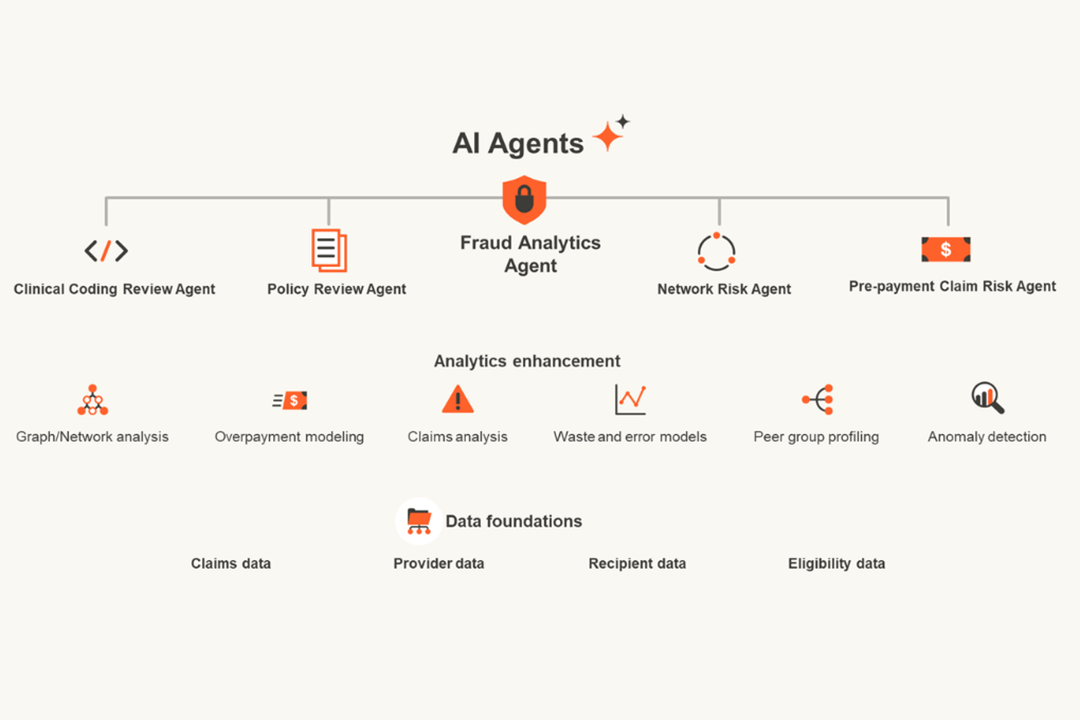
With an intelligent payment integrity platform, specialized Fraud Analytics Agents can link data sources to analytics results, supporting human FWA analysts in moving from reactive to more proactive oversight.

Infographic showing AI agents, analytic enhancements, and data foundations Infographic showing AI agents, analytic enhancements, and data foundations

Use case: Supporting AI through intuitive tools

Capabilities like the tools below can help states to leverage AI, regardless of cloud provider:

  • Query tool: Supports the translation of natural language questions to structured query language (SQL)
  • AI help: Supports retrieving data using natural language questions
  • Policy to SQL: Assists with generating SQL from uploaded policy documents
  • AI analytics & backstory: Helps provide background context and analytics using LLM

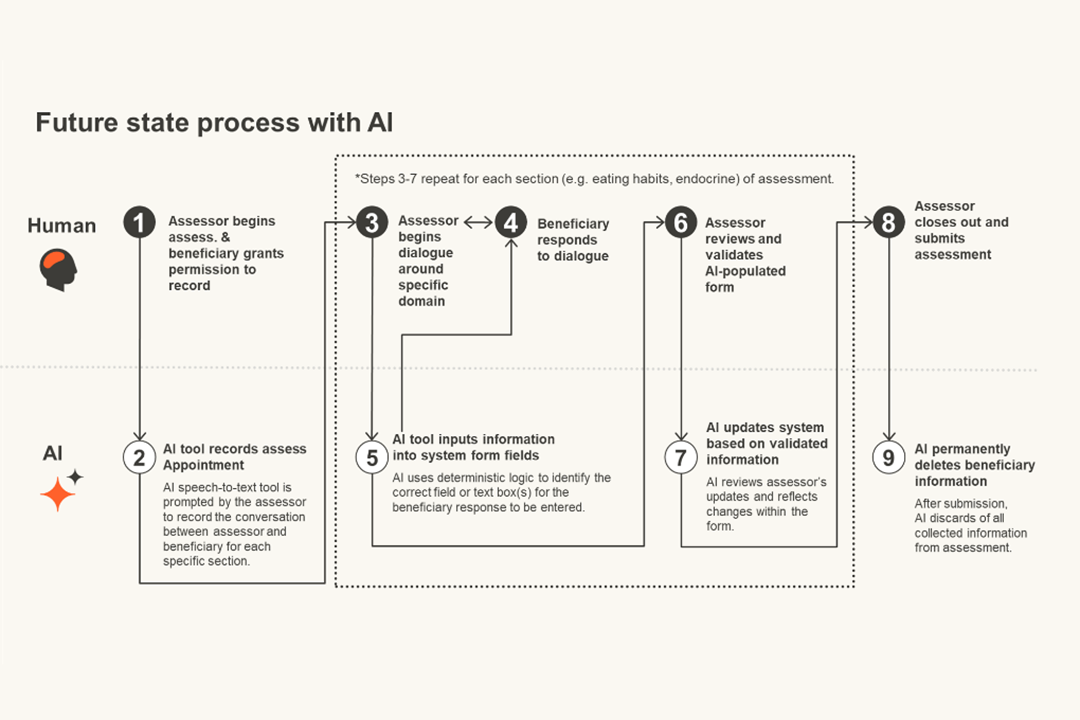
Use case: Supporting voice-based assessment interview

Today’s health care assessment interviews often involve manual, time-consuming processes. AI can support the human role by automating tasks that help reduce clinician burnout and improve productivity.

Infographic showing the future state process with AI Infographic showing the future state process with AI

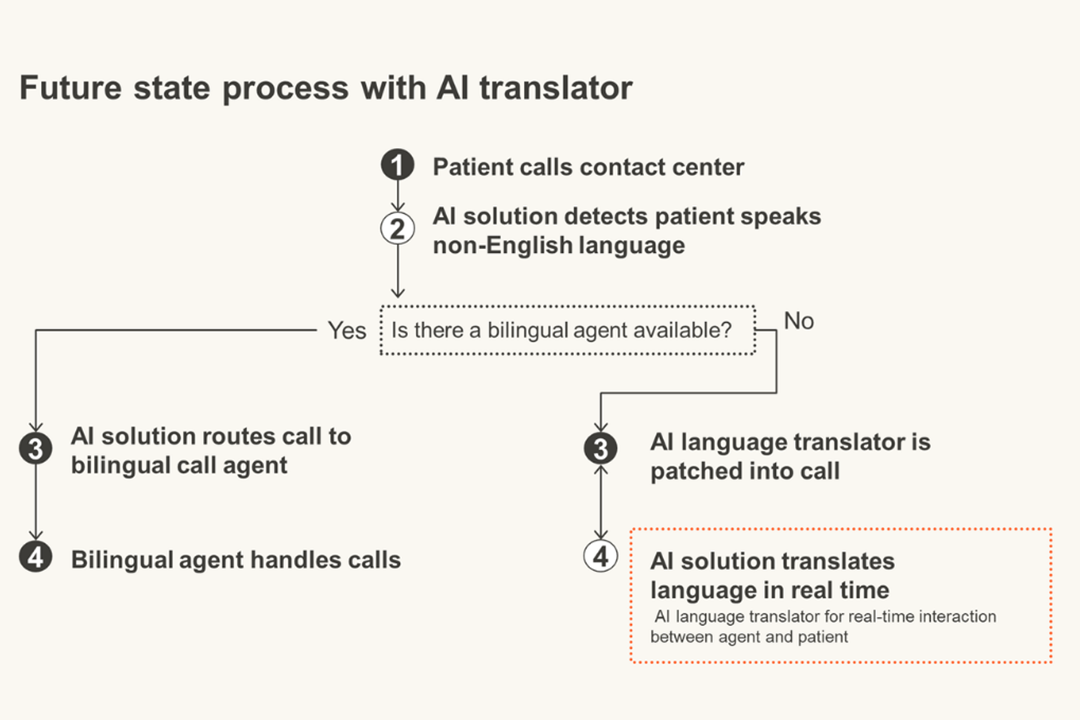
Use case: Providing translation support for contact centers

For contact centers, AI removes common friction points such as language barriers, long hold times and manual routing to aid in more equitable health care communication.

Infographic showing the future state process with AI translator Infographic showing the future state process with AI translator

Apply AI responsibly in your state

Responsible AI extends beyond a compliance checkbox — it underpins trust, fairness and long-term sustainability in health programs. By framing governance and safeguards as part of a broader commitment to ethical innovation, states can position AI solutions not only meet applicable technical standards while sustaining public confidence and equity considerations. As Karl Schelhammer noted, “Strong governance is critical. It lays the foundation for successful AI — aligned to frameworks like NIST AI RMF — so decisions remain transparent, explainable and fair.”

These key considerations are intended to promote AI development within state health programs.

  • Goverance first
    • Establish an AI governance framework aligned with NIST AI RMF. Define roles, accountability and risk controls prior to broader deployment.
  • Transparency and explainability
    • AI‑supported decisions should be designed with human-readable rationale and documentation appropriate for audit and review. This approach can encourage fair hearings, public records and compliance review processes.
  • Bias and equality safeguards
    • Evaluate for potential disparate impact across populations and incorporate language access considerations and alignment with ADA/WCAG accessibility standards compliance for outputs.
  • Interoperability and standards
    • Design for CMS FHIR APIs and T-MSIS data quality from day one. Avoid siloed solutions — by enabling integration with MES modules and broader state data ecosystems.
  • Lifecycle risk management
    • Continuous monitoring for model drift, security and performance and defined incident response playbooks to guide rollback and remedoiation as appropriate.

AI in Action

Good morning, everybody. My name is Carl, and I’m here today to talk to you about how AI is transforming healthcare, specifically through practical use cases and the impact those use cases are having in Medicaid systems.

As I mentioned, my name is Carl Shell Hamer. I lead artificial intelligence and machine learning initiatives for state government solutions. Here at Optum Insight, I’m joined by James Luen, who leads product strategy, and Sumit Cara, who has deep experience in state government, software engineering, and sales.

Today, we’re going to talk about our vision for AI as it relates to Medicaid solutions and illustrate that vision with a couple of practical use cases, along with the real-world impact they’re having.

I’d like to start by grounding us in the “why.” Why does this matter for state health programs? These programs face several major challenges today. One is rising complexity in Medicaid operations and compliance. There’s also significant strain on the workforce and an increasing administrative burden. Finally, there’s an urgent need to improve equity and patient and provider experiences.

The complexity in these systems is exploding for several reasons. There are thousands of rules, countless policies, and enormous volumes of data to manage. Medicaid systems are jointly administered by state and federal governments, which adds further complexity. Implementations often require extensive custom development, which increases both cost and risk.

At the same time, staff are overwhelmed by the volume of compliance, reporting, and administrative tasks. During the height of the COVID pandemic, Medicaid enrollment peaked at roughly 93 million people, driven largely by job losses. While enrollment has since declined, pressure in the labor market remains, and workforce strain continues.

Equity is another critical issue. Language barriers and other obstacles disproportionately affect vulnerable populations, leading to delayed care, avoidable emergency room visits, and poorer outcomes. States are also under pressure to measure program effectiveness from an outcomes-oriented perspective, which requires timely, actionable insights.

Our vision for addressing these challenges centers on transforming AI from a simple tool into a trusted partner that helps deliver smarter, more equitable healthcare solutions. That vision rests on three pillars: democratizing data access, workflow automation, and insights generation.

Democratizing data access is essential because Medicaid data is highly siloed across many disconnected systems, some of which are decades old or built on obsolete technologies. We aim to introduce natural language interfaces that make it easier to access insights hidden across these disparate systems. This allows users—from policy leaders to clinicians—to complete tasks more easily and efficiently.

Workflow automation is another key focus. Many tasks, such as fraud detection, are still highly manual and time-consuming. By applying AI to these processes, we can reduce risk, standardize workflows, and significantly decrease manual effort. This enables teams to work faster, achieve greater precision, and scale to larger workloads.

The third pillar is insights. Timely, relevant insights are critical for good decision-making. We’re using AI and natural language interfaces to make data visualizations more accessible and to keep dashboards up to date, ensuring leaders are looking at current information rather than data that’s days or weeks old.

Building on this foundation, we’re developing a set of core AI capabilities. These include AI voice translation for call centers, which improves access to care by enabling real-time multilingual conversations; voice-based assessments that automate data capture while allowing clinicians to focus on patients; and quality audits that scale call analysis to provide timely feedback and root-cause insights.

We’re also applying AI and machine learning to fraud detection, including identifying suspicious billing codes and high-risk transactions. Document AI simplifies enrollment and verification by extracting and validating information from uploaded documents. Virtual investigators automate much of the fact-finding involved in fraud investigations, while graph analytics help uncover hidden relationships, anomalies, and referral loops across datasets.

Insights remain central across all these capabilities. Our goal is to ensure decision-makers consistently have the right information at the right time.

Focusing more deeply on program integrity, we see AI agents as the future. These agents operate on top of a foundation of claims, provider, recipient, and eligibility data, enriched with advanced analytics such as graph analysis and anomaly detection. Instead of analysts manually writing SQL queries and navigating complex data structures, AI agents can retrieve data, recommend next steps, and interact with advanced analytical tools, allowing humans to focus on higher-level reasoning and judgment.

We’re also using AI to accelerate our own software development lifecycle. From intake and ideation through planning and implementation, AI tools help convert rough ideas and meeting notes into structured requirements, Jira stories, and executable plans. This dramatically reduces planning cycles and increases development velocity.

Internally, we use tools such as enterprise ChatGPT, AI-enabled Jira workflows, GitHub Copilot, and workflow automation platforms to boost productivity. These tools allow teams to focus on higher-value work while reducing repetitive manual tasks.

We see similar opportunities for modernization in state systems that rely on decades-old technologies. AI enables faster and more cost-effective migration to modern platforms such as Snowflake and Azure, reducing maintenance costs and accelerating return on investment for states.

At this point, I’ll turn things over to James to demonstrate how these ideas translate into real solutions.

James introduces an AI query tool that allows analysts to write natural language queries instead of SQL. The system maps those queries to verified database queries, enabling users who aren’t SQL experts to interact directly with data. This capability is complemented by an AI help feature that allows users to query system documentation conversationally, making complex systems far easier to navigate.

James also demonstrates a policy-to-SQL engine, which converts Medicaid policy text and database schemas into executable SQL queries. This dramatically reduces the time required to develop analytics while still keeping humans in the loop for validation and refinement.

The conversation then shifts to virtual analysts and investigators. These systems automate the execution of reports, summarize findings, and generate executive-level insights. Analysts can then focus on interpretation and action rather than data gathering.

Sumit presents a practical use case focused on clinical assessments. Today, assessments involve extensive manual chart review, documentation, and follow-up work. AI can automate pre-assessment summaries, transcribe conversations during visits, align documentation with NCQA standards, and generate personalized care plans. This reduces clinician burden, improves data accuracy, and enhances patient engagement.

Another use case focuses on contact centers. AI-powered language detection and real-time translation remove language barriers, reduce wait times, and improve both patient and agent experiences. AI can route calls to bilingual agents when available or act as a live translator when they are not.

The session concludes with a discussion on responsible AI implementation. Key considerations include governance, transparency and explainability, bias and equity safeguards, interoperability, and lifecycle risk management. Strong permissioning, clearly defined AI agent scopes, and human oversight are critical to ensuring safety and trust.

The presenters emphasize that AI is an accelerator, not a replacement for human judgment. Human review remains essential, particularly for high-impact decisions, policy interpretation, and governance.

Related healthcare insights

View all
Pharmacy Benefit Management Solutions, Built for You

Article

Pharmacy benefit management solutions, built for you

Clear pricing. Aligned scale. Actionable insights — helping you make smarter decisions, faster.

5 Questions About AI Use in Pharmacy Benefits

Article

5 questions executives are asking about AI in pharmacy benefits

Discover the unique challenges and responsibilities of introducing AI into pharmacy benefit solutions.

Maternal Health Transformation: State Strategies & Analytics

Case study

Transforming maternal health: A roadmap for states

We offer analytics, consulting insights and real-world application for states to improve maternal health care for women enrolled in Medicaid.