Article

Top 5 ways Optum Rx is putting AI into action

See how we’re using AI to make pharmacy care faster, more personalized and proactive.

June 8, 2026 | 6-minute read

The advantages of artificial intelligence (AI) will become clear by implementing more high-value use cases.

Optum recently reviewed more than 450 research sources addressing AI in healthcare.1 What we found was eye-opening:

  • AI in healthcare is moving from conception to operational reality across claims, eligibility, service, revenue cycle, care delivery and research.
  • At the same time, the conversation is shifting from possibility to proof, with less tolerance for broad innovation language and more demand for visible operational value.
  • Buyers also now expect strict responsible-use AI guardrails to be in place, including explainability, human oversight and clear accountability – where AI affects coverage, care, compliance or customer trust.

That’s why every Optum AI initiative is grounded in Responsible AI with guardrails for fairness, transparency and compliance. This ensures trust, reliability and alignment with regulatory expectations. In other words, clients and plan sponsors are tired of sifting the hope from the hype.

Here’s a look at the top 5 AI and advanced technology use cases that are materially improving pharmacy care services. These initiatives are either fully launched at Optum Rx, or are in the process of being rolled out. Also, be sure to see our review of the top 5 questions plan sponsors are asking about AI.

1. Optum Assistant

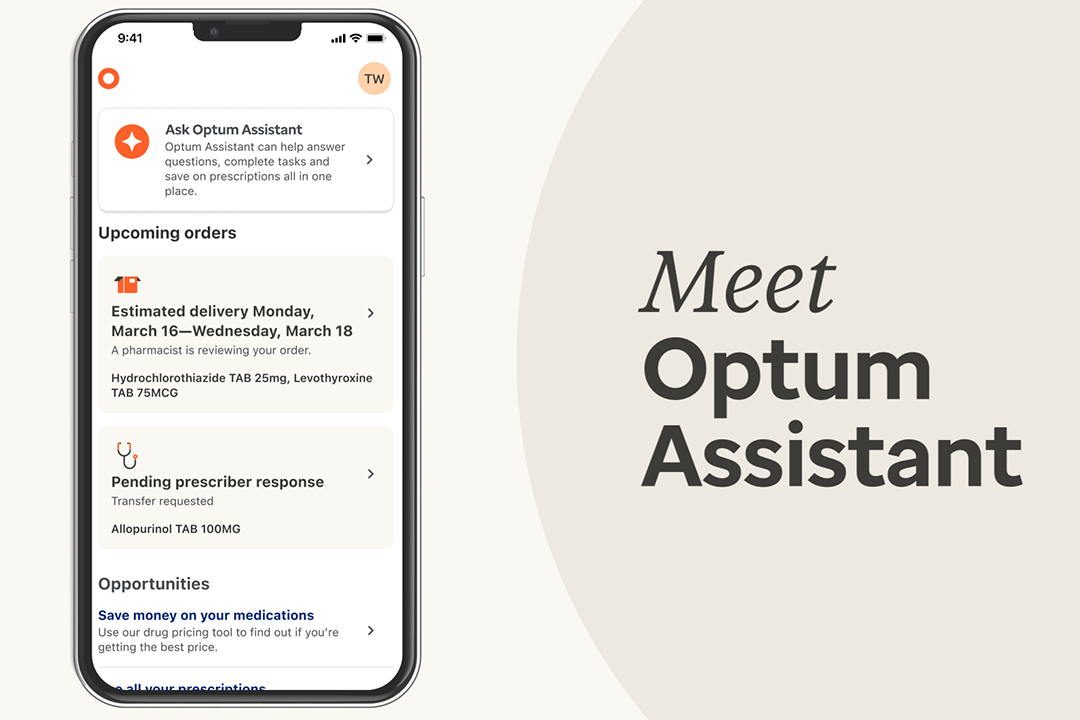
Optum Assistant evolves how members, clients and employees navigate pharmacy benefits and prescription needs – helping resolve requests and questions with clear, conversational AI guidance. We are leveraging this technology to deliver proactive, personalized support for the 62 million people we serve. Every interaction is designed to make health care simpler, clearer and more connected.

Optum Assistant is not just a chatbot. It can:

  • Analyze data in real time
  • Understand intent
  • Proactively help guide users to the right action
  • Shift routine questions to digital self‑service
  • Support better first‑time resolution through predictive routing for members, clients and member advocates

For members

Optum Assistant proactively verifies coverage, identifies savings, answers prescription questions and completes requests automatically within the mobile app and portal. Provides intuitive, self‑service answers that build confidence.

For clients

Optum Assistant automates requests, inquiries and pharmacy tasks in Optum Rx Benefit Central™ without manual intervention. That means clarity on benefits and pharmacy questions and faster turnaround times.

For customer service advocates

Optum Assistant helps resolve consumer needs more quickly during calls. It helps the customer service advocates by explaining call reasons, answering questions, identifying next-best actions and resolving member needs more quickly during calls.

By 2027, we expect Optum Assistant to be at scale with multilingual support.

Real impact

The result is consistent, personalized and proactive responses at scale for better member and client experiences.

2. Pharmacy fraud, waste and abuse

Pharmacy fraud, waste and abuse (FWA) costs the U.S. healthcare system an estimated $3.5 billion annually.2 For plan sponsors, this means:

  • Unnecessary expense
  • Operational inefficiencies
  • Potential patient safety risks.

Optum Rx is tackling this challenge head-on with AI.

Our AI-powered solution detects and prevents fraud, waste and abuse with greater precision and efficiency. This helps clients save money, reduce pharmacy abrasion and protect members.

Key results:3

  • 173% higher financial recoveries per confirmed fraud case.
  • More than doubled accuracy in identifying true fraud.
  • 116% boost in fraud detection precision and accuracy.
  • 53% year-over-year growth in identifying and reclaiming inappropriate pharmacy spend associated with FWA.

Even more importantly, by being more precise, AI allows us to perform fewer unnecessary audits — reducing them by up to 35%.4 This means less disruption for pharmacists and improved patient safety all while delivering measurable savings.

3. Predictive call support

Our Optum Rx predictive modeling engine is transforming member engagement through AI, anticipating member needs for faster, more seamless support.

AI can now predict a member's likely intent via their call, (chat, web and app coming soon) without needing to directly ask them. Our predictive modeling engine can:

  • Analyze data in real time
  • Predict top reasons for the call
  • Use that prediction to route the member to appropriate self-service options or to connect the member to the correct member support advocate, avoiding multiple transfers

Key results:

  • AI accurately predicts the intent for more than 50% of these calls.6
  • 11% of calls were resolved through self-service, eliminating the need for agent intervention, and approximately 300K follow-up calls were eliminated annually through improved member intent capture.7
  • In 2025, 80% of potential member issues identified by AI were resolved without a callback or escalation.8 That means less friction for members, lower operational burden and more capacity for advocates to focus on higher‑value, complex cases.

Predictive support is now live in our IVR system. In 2026, we are expanding this capability into our OptumRx.com consumer portals and mobile apps, our live & AI-assisted chat experiences, and more.

4. Pharmacy safety and speed

Pharmacy AI innovations are embedded across Optum pharmacy operations ​to support enhanced clinical focus, accuracy and faster therapy starts. This is operational AI at scale embedded directly into pharmacy workflows focused on preventing issues, not reacting after disruption occurs.

Here are two examples of how AI is enhancing pharmacy operations across Optum Rx:

Example A: AI prescription standardization improves existing patient safety efforts

Our new Pharmacist AI Assistant has an AI prescription direction patient safety feature that translates complex prescriber free-text shorthand prescription directions into clear, standardized patient-friendly directions to reduce errors and improve patient safety all while preserving pharmacist oversight. 

This is important because across the industry, 75% of quality-related pharmacy events are due to inaccurate directions for use. This new AI-driven clinical decision support improves patient safety enabling 96% accuracy in standardized prescription directions.9 Standardized clear directions reduce patient confusion and improve patient safety. A 50% reduction in manual pharmacist review allows greater focus on clinical validation and patient care.10

This system is purpose‑built for pharmacy complexity, not generic text translation.

Example B: Streamlined call documentation

A common challenge in contact centers is that great service can be undermined by inconsistent documentation. We’re using conversational AI to capture key details during the call and automatically create a high-quality, structured summary.

The resulting 15 second reduced average handle time yields a better member experience through fast and accurate first-call resolution and fewer repeat calls.11

5. Prior authorization analysis

We’re using AI to streamline prior authorization (PA) preparation for specialty and infusion therapies by automatically pulling information needed to complete the PA.

The AI scans provider‑submitted documents and pinpoints the exact medical details required for the PA based on the drug policy criteria. It then auto‑fills those answers into the PA form. This reduces back‑and‑forth with providers, minimizes missing information, and supports consistent interpretation of clinical criteria across teams.

Solving for the toughest prior authorizations

What sets this capability apart is its ability to handle the complexity of both specialty and infusion PAs. Each relies heavily on document‑based evidence and nuanced clinical detail.

The tool is trained to follow the correct drug policy requirements and is developed under responsible AI governance practices, designed to mitigate bias and unintended outputs.

Key results:

  • 45% (nearly half) faster review to answer PA questions for plan submission.12
  • Average score 4.83 out of 5 for usability and performance among pharmacy agents, reflecting how effectively it reduces friction in their daily workflows.13
  • Improved completeness of PA submissions reduces rework and helps accelerate overall turnaround time from initial submission to decision.14

With more complete PA submissions and fewer manual steps, providers get faster decisions and patients can begin therapy sooner. This is especially critical in complex specialty and infusion cases.

Optum Rx is moving the needle on AI

At Optum Rx, we’re using AI and advanced technology to make health care transparent, simple and affordable at scale today. AI is yet another example of how we bring our mission to life: creating a health system that works better for everyone, one experience at a time.

Related healthcare insights

Article

5 questions executives are asking about AI in pharmacy benefits

Discover the unique challenges and responsibilities of introducing AI into pharmacy benefit solutions.

Article

What’s next for AI in pharmacy?

Two AI experts share insights on how we’re using AI and advanced technology to improve everything from trend prediction to member services.

Article

Building trust in AI: A responsible approach

At Optum Rx, we’re using AI responsibly — fairly, safely, ethically — to make health care easier and better for the people we serve.

  1. Optum internal analysis. Synthesis window: January–March 2026.
  2. Cost Effective Resource Allocation. Predictors of loss due to pharmaceutical fraud: evidence from the U.S. Published February 12, 2022. Accessed April 21, 2026.
  3. Optum Rx internal data, 2024.
  4. UnitedHealth Group. Using AI to lower costs, reduce pharmacy errors and protect patients. Published March 5, 2026. Accessed April 21, 2026.
  5. Optum Rx internal data, 2024-2025.
  6. Optum Rx IVR data, November 2025.
  7. Optum Rx internal data, November 2025.
  8. Proof of concept analysis shows 80% of members assisted through the PARIS model do not escalate within 10 days.
  9. Optum Rx internal analysis, 2025.
  10. Ibid.
  11. Optum Rx internal data, 2024-2025.
  12. Optum internal data 2025.
  13. Ibid.
  14. Ibid.