
On-demand webinar
Succeeding under CMS TEAM: an AI‑enabled performance playbook
Hear from Optum experts on how hospitals can successfully manage cost and quality across 5 episodes of care under the new CMS model, TEAM.
Succeeding under CMS TEAM
Hello everyone and thank you for joining today's webinar Succeeding under CMS Team, an AI enabled episode performance playbook. My name is Brittany Turman with Optum and I'll be your host. At the top right of your webinar screen are multiple application tools that you can use to customize your viewing experience. If you'd like to learn more about today's presenters, you can do so via our speaker bio tool located to the left of the slide deck. Below the slide deck, we have a few related resources that are available for download. To the right of the slide deck, you'll find our Q&A tool.
You can submit questions in the Q&A tool at any time. Would you capture all questions? And we'll follow up to questions as appropriate. We also have a survey tool which you can use at the end of the webinar to provide us with feedback on today's session. We value and welcome your opinions regarding today's event. You can expand your slide deck area by clicking and dragging any of the slide window corners or sides. You will receive an e-mail within 24 hours of this live webinar with a link to the on demand recording of this event.
This presentation does use streaming audio through your computer speakers to ensure the best possible system performance. Please be sure to shut down any VPN connections and connect directly to the Internet. If you have any technical difficulty, please click on the help tool. It covers common technical issues. And with that, I will now turn the presentation over to Sabashani Umapathy, Director of Product with Optum. Thank you. Good morning, everyone. Thank you for joining us. This is Subhash Nimapati, Senior Director of Product at Optum.
I spent the last 16 years building analytics and AI solutions for health systems. I'm joined today by Jennifer Liaso. Jennifer, would you like to introduce yourself? Good morning, everyone. I am an actuary with over 30 years of experience helping providers and payers reach collaborative reimbursement models such as these bundled payments. I'm excited to talk about what CMS has proposed for this program or is implemented. It's no longer a proposal. Thanks, Jen. Here's what we'll cover today.
We'll start with the CMS team mechanics and talk about what's inside a team episode. We will walk you through strategic pathways for succeeding on a team. We will then introduce you to Crimson AI, our analytics platform that can help you manage team performance. And then we'll close with questions. Before we begin, let's do a poll question. I will encourage everyone on the call to interact with us through these polls. Here's the question. How ready do you feel for team reporting today? Not started and need help?
You're in the early planning stage, active building stage, are confident and operating. We'll give you 30 seconds to respond. Would love to see your responses. Waiting for a few more responses. OK, Majority have said actively building next is not started. So for those who have not started, that's exactly why we are here today. For those who are actively building, you're going to see a lot today that validates what you're doing. Let's start by grounding everyone on what TEAM is. TEAM stands for Transforming Episode Accountability Model. This is a mandatory bundle payment program from CMS.
Roughly one in 10 hospitals in the US from selected geographic areas are required to participate. The program has four goals. First, reduce medical expenditures. Second, enhance quality of care. 3rd, improve care coordination and lastly advanced HealthEquity. These goals were designed with the understanding that some beneficiaries undergoing surgeries may go through fragmented care that can lead to complications, readmissions and increase spending. Team aims to solve this by holding acute care hospitals accountable for the quality and spending performance for the entire 30 day surgical episode and this includes the patient's hospital in patients day or the outpatient procedure and the 30 days following the hospital discharge.
The program focuses on five procedure episodes, lower extremity joint replacement or Lejr, surgical hip femur fracture treatment or shift, coronary artery bypass graft or cabbage, major bone procedure and spinal fusion. CMS chose these procedures because they represent high expenditure and high volume care delivered to Medicare beneficiaries. This is a 5 year program started in January 2026 and ends on December 31st, 2030. With the potential for future expansion. It's high time for hospitals to be prepared now, Jen, We'll talk about the various participation tracks that are part of the program. So it is a mandatory program and you know, several geographies, but there was an option to opt in as well.
I believe that opt in provision was, you know an in year 1 only. I would imagine most of the participants are in track 1. Track 2 is limited to safety net hospitals and other rural facilities and track 3 has more downside and upside risk early on in the program. Most of the clients that I've talked to have selected year one where I'm sorry, track 1 where year 1 is only upside risk. So we are in April of the first performance year. CMS has been very slow in getting out information as typical because of the paid claim lag, excuse me.
And so at this point, you know, 1/4 into the program, there's very limited visibility into performance. And so a lot of people took that track one, just to be able to see how they perform, get their feet wet and start making small changes in preparation for year 2. So we're hoping that we can engage in some meaningful conversation at this point now that we are, you know, almost halfway through year one performance period. But the year 2 is where everyone is going to take downside risk. And so that's why we're having this conversation now trying to help folks be prepared for the risk that is coming down the Pike next year.
Sebastne, you want to talk through a sample case example? Oh, Nope, sorry. Next is me. So what you've first two boxes on the left, if you've, if you're a mandatory participant or you've elected to participate, you've received your baseline data and your preliminary target prices. We won't have what those final prices are until basically the end of the program. And that's typical in a lot of these programs. There are things like risk adjustment that won't be finalized. We won't know what the risk score is of the patients that were treated in the performance year and the retrospective trend adjustment that we won't know what kind of the target is that you need to be.
The windsorization or removing of episodes over the 99th percentile won't happen until we have all the episodes. But at this point, you should have a clear understanding of what your preliminary target prices are with the information that CMS has provided. What the tool is going to help show is how we can predict what the quality score is for the different year measures, which are spelled out below, and I won't read those out to you. Most of these measures are items that have already been reported elsewhere either. They're calculated from claims that you submit to CMS, their quality terms that you submit elsewhere through the hospital quality reporting.
The biggest change is the patient reported outcomes that needs to be submitted for the first time for this program. At the very end, there are two adjustments. So once we understand the quality, we adjust the actual payout by the quality factor as well as whatever those stop loss gain share provisions are that you chose depending on what track you're in. The last adjustment is going to be post episodic spending greater than 3 standard deviations above regional. And that really is intended to prevent unintended consequences of implementing a program like this and having providers shift care outside of the episode and on to someone else's responsibility. You know, CMS has has learned a lot from unintended consequences over the years.
There's why we have things like the risk score, coding intensity factor. There are all sorts of factors that are implemented into the methodology, but that last factor is really intended on making sure that you're not withholding hair in that 30 day episode and pushing expenses outside. The idea here is that you collaborate with post acute facilities to partner to maintain the best quality of care for the patients, to get the patients home as quickly as possible. And so we'll talk a little bit more about choosing partners within your post acute strategy in the upcoming slides. So as an example, we're going to walk through just a particular patient who presents for LEJRA hip procedure that we have the initial episode in the hospital that is what triggers the the episode.
Is that either inpatient DRG or an outpatient CPT code in an outpatient surgical setting. What happens after the the surgery? Some we need to make sure that information is shared across all of the providers that are touching that patient as best as we can. And that's where I think CMS is really trying to push the improvement in the quality and type of care that is delivered instead of every provider just thinking about the piece of service that they're providing. You know, in this particular episode, we have that the patient goes home with home health, which is great. But if there is continued pain and that patient would return to the Ed, that is cost that will count towards the episode.
So creating a pathway for that patient to get care outside of going to the Ed or even outside of going to a sniff is important. Any unexpected concerns about the surgical procedures such as a wound or sepsis around the the scar, you know, we need to be aware of. And so sharing that information within a physician in a hospital tends to be pretty straightforward within the EMR. But connecting those dots across facilities to a post acute care, either a home health provider or a sniff provider is typically where information breaks down. And so we're going to talk a little bit about how to improve that.
Sebastian, is there anything else you'd like to add to this slide? No, you just covered it all. Jen, please go on. Great. So in this case we have a target price for the LEJR is $50,000. It's because this patient did not go to a a sniff. They went home. With home health. They were actually able to decrease the cost of $46,000. That leaves 80,000.
I'm sorry, that leaves $4000 as the initial growth savings, but that is adjusted by the quality component and the gain share amount of 10% or $5000 Max 10%. The the the stopgap limit is 10% of the target price. So the Max that they would pay is is 50,000 is $5000. So in this case the the reconciliation amount would be 3920. And then each individual episode that is occurred within the hospital, that math gets summed up across all of the episodes. And that's how the financial reconciliation is determined.
Couple of things I want to talk about, you know, the risk adjustment, understanding how the patients you treat are different relative to your peers. So this is a normalization factor. It's not just my patients are sicker than yours. It is how much difference does my risk score change than my peers. So if your peers are able to adapt and maximize the risk score based on the the program then and adapt policies and procedures that will maximize the risk score faster than you, you could be left behind. So this is important to understand. It's very similar to what CMS does in MA, but it is a bit different in the sense that there are.
We're going to talk a little bit more about the details of that on the next slide. The trend factor, this is basically a national trending that gets applied and then every episode has a, a discount factor that gets applied in the target price between 1 1/2 and 2% depending upon what the episode type is. These reports you'll get, you get information monthly about the the episodes that the hospital has initiated and then they will give you a sample reconciliation report. But those are very lagged. And so like I said here we are three months into the program and we only have one month really only three weeks of of information at this point of episodes that were started the beginning of January.
So some common hurdles that can impact what your target price is, is, you know, understanding where you sit within your Geo, your geographical range, are you do you practice medicine different than the peers in your geography. So the the target price starts with with the average DRG reimbursement. It's a standardized price. So it takes across, it takes out differences that are known in the inpatient perspective payment system programs such as base rate differentials, you know, wage index differentials. It'll normalize out for things that are mathematically a function of the reimbursement. But if there are differences in practices across geography within these states that could either put you ahead or behind your peers.
So understanding those geographical differences of how you deliver care in your hospital is different than the peers in your geography is important site of service. We talked about that this particular L EJR case was done outpatient and there is quite a variance. I, I used particular spine fusion CPT codes in this example. But if these are DRG case, if I use a national average base rate times the weight to determine what the the standardized normal allowed amount might be for the DRG, we're at 16,500. Call it. If that same procedure was performed or a procedure that was performed outpatient that maps to the same DRG level, that reimbursement on a national level is only 13,000.
So you can see that $3000 difference in DRG 473 and close to $4000 difference on DRG 471 can create variances relative to that target price. That target price is going to take the regional average distribution of in and outpatient services relative to you as your own hospital. So if you're ahead of the curve and doing more services outpatient, kudos, you're going to likely perform better relative to the target. But if you're above, you're going to be behind the target and then you also have to worry about improving yourself relative to all your peers in the region because presumably this model will help providers or incent providers to start performing more services outpatient.
And lastly, as we talked about the risk scoring, it does use the HCC construct, but instead of HCCS in the MA where it's what was coded in the year prior impact reimbursement, you know the following year, there are limits in terms of what is coded 6 months prior to the episode. So your typical MA risk coding for these fee for service Medicare patients isn't going to be sufficient to help maximize your risk scoring in this model. It's very important that you have that surgical clearance appointment with APCP to document all of the conditions in advance so that the patient is risk coded appropriately. And a lot of these episodes end up as emergent surgeries, especially, you know, the the hip fractures where the patient falls, ends up in the ER and immediately goes to surgery to fix the hip.
At that point, you can't code if that patient hasn't been seen by APCP in the six months prior to that emergency room episode. So I do see CMS starting to think through how can I, how can the the program help incent providers to see patients more frequently, to code them appropriately to perform more services at a lower cost side of service such as outpatient surgery and start to improve competition among peers. And we know that, you know, CMS has a goal to get as many patients within the a value based arrangement by 20-30. These, this is just one more program that they can count as opportunities to have a patient in Medicare in a value based program.
We've seen CMS do bundles before. So this is not new. I think what they've taken learnings from their past programs from Bipsy etcetera and have started to narrow into where they think they can make a difference. So we do think that this program has taken a lot of learnings from prior programs, specifically in that it's only the surgical bundles, they've eliminated the medical bundles. So those providers that are, you know, surgeons that impact these types of episodes really need to pay attention and aligning incentives across the hospitals, the surgeries in the post acute care area is what's most important. So full question again, what is your most challenging item today?
Is it the data and having that information timely? Is it tracking the quality and utilization, managing the cost and quality after discharge? Or, you know, understanding that whole 30 day spectrum of the episode roll out a bit of time for folks to respond. Give it a few more seconds. Maybe it's all of the above. All right, let's see what all of the above followed by procuring data timely. Perfect. We're going to talk a little bit more about the the structure of the program and then kind of a teams one O 1 and then we'll get into a little bit more detail.
Sebastian can get into more detail about how to help you answer some of those questions. So it's very important for you to understand as we talked about how, how your performance is relative to that target pricing. We've gone over a, a, a bunch of detail in this area. So not going to belabor these points, but under need to understand just because you were below benchmark before doesn't necessarily mean you'll be below benchmark in the performance here again, because the idea is you're continuously moving the target relative to your peers in the factors such as the risk normalization and the national trend, the risk, the retrospective trend adjustment that gets applied to the benchmark price before you get to final.
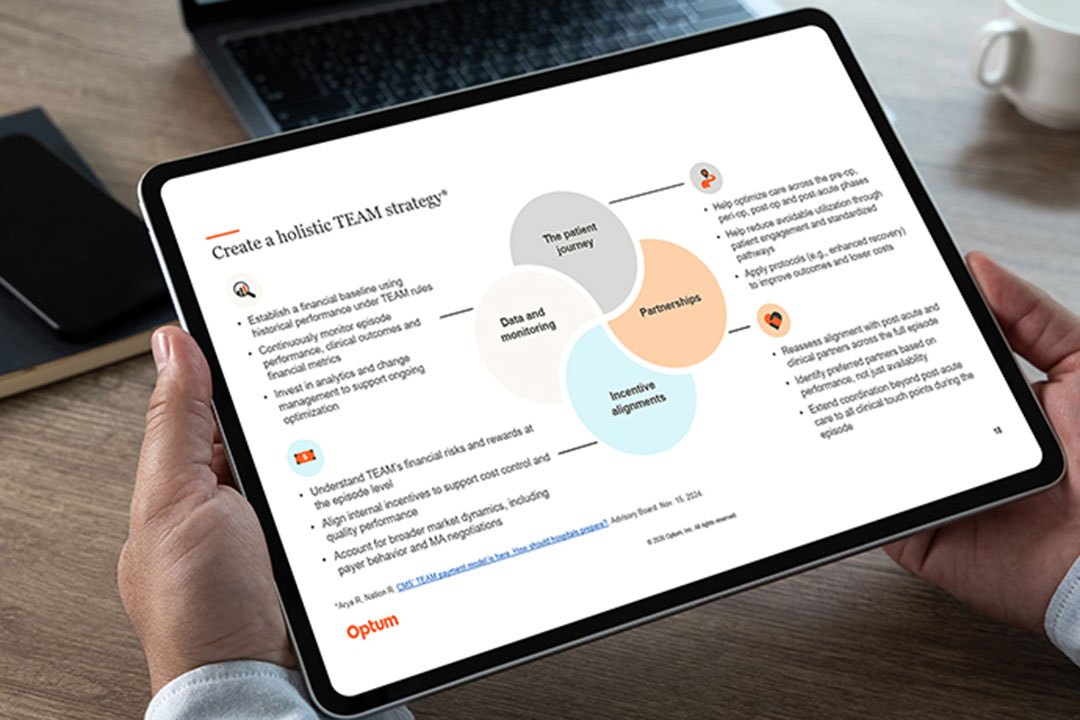
So just because you think that you are performing well against your proposed target, need to make sure you leave way in that analysis for negative impacts on risks scoring and trend analysis as well. I think that the last piece I want to talk a little bit about here is how all of these areas impact the team strategy. So we've talked a bit about the upper left data and monitoring how to use the information, what information you do have available. I can go counterclockwise. We've talked a bit about, you know, program parameters that prevent unintended consequences by shifting services outside of the episode.
I think what's important is aligning those incentives as we talked about across your providers and your post acute care providers specifically to provide to share information, to get real time information so that whoever you know the organization that's ultimately responsible, the hospital is able to see information about the patient. So being able to align those incentives requires on the right lower quadrant partnership, partnership with post acute care facilities, making sure you have the right facilities, supporting the episodes that you are discharging, extending coordination. Maybe it is a additional resource that helps span to that patient across transitions of care etcetera. And then, you know, what's important is really to focus the patient and understand how to help the patient heal appropriately in the best side of service, which is often the home.
Avoid bounce back to the Ed, avoid readmission, which benefits everybody. And so having a clinical resource or protocol in place when that patient calls the doctor's office about a complication that there are other ways to help the patient moving forward. So it really is not just one person's responsibility to make this program effective or, or have favorable financial results, but we have to work together. In a couple of these slides, there are links at the bottom where there have been publications from our organization as well that might be useful for you to look at and consider other inputs that might not be reviewed here.
Sebastian, you want to talk about 5 things that winning teams are doing? Awesome. Jim laid out a framework for a holistic team strategy and we saw from the poll that there is problem everywhere to manage team. Now I want to leave you with five tangible things that would separate a high performer from the rest, not just for team program, but for any bundle payment program in future. First, track performance before CMS does winning hospitals would know their constraints well ahead of reconciliation. That's number one.
Second, engage and align providers as partners. Health systems who've had success in bundle payment programs in the past are the ones who brought their surgeons early in the process. They had them see their own data and set shared targets and incentives. So surgeons who see their own data change their behavior. Surgeons who don't don't next track and manage post acute performance then talked about it. Most hospitals have the least visibility when it comes to post acute care. Successful health systems track their pack performance more seriously. Some we've seen that they've used even real time ADT alerts so they'd know the moment a patient lands in a low performing pack facility and so the care teams can intervene before the car spirals.
And they've had successes with that. Next, treat quality as a reconciliation driver. Most hospitals track quality measures like readmissions and complications, but they are not yet prepared to track patient reported outcomes are prom. Your PROM capture directly impacts your composite quality score and in turn your reconciliation. So hospitals that build the infrastructure now for prom service are well positioned for future. Lastly, use equity as an operational lever. Equity adjustment is built into the team payment structure. This is to help hospitals that are treating patients with social risk.
So ignoring equity means leaving dollars on the table. So it's important to do three things systematically. Track for social risk in patients, document them in the ICDZ course on the claims, be it housing instability or food insecurity or transportation barriers. Lastly, use the same social risk data to route patients to the right resources before discharge. Now let's talk about measurement 3 categories. Let me hit the ones that matter the most. On the financial side, total cost of care per episode is your North Star, but to manage it you need to see it broken down by components and benchmarked. Average length of stay is your liver, both on the inpatient side as well as on the backside because every extra day has a dollar amount attached.
On the quality side, your composite quality score is your primary KPI. Make sure to track also the post discharge follow up rate because that's an early signal for readmission risk. On the utilization side, three things to watch. One, are you doing the procedures in the right care setting or defaulting to the inpatient when outpatient works? 2 are you sending patients to the right post secured care or are you defaulting to sniff? 3 Are you using telehealth for follow-ups when patients have transportation barriers? In short, no single KPI tells you the full story on the team.
Every metric here that you see is intertwined and connects to your overall outcome. In a few minutes, I will show you how they all come together and help you manage team. But before we proceed into the next section, let's do a poll. Jen, please take it away all. Right, I was on mute. What limits your ability the most in order to effectively manage the 30 day episode? Limited visibility to care outside your system that we've talked about detecting post discharge events quickly, gaps in data interaction or integration.
Maybe you do have information in ADT feeds, but there is a lack of acceptance from a sniff facility in terms of reporting to that particular feed, aligning with post acute providers, or just too many things to focus on and not understanding where to focus your efforts. Give it a few more seconds. Let's see where we are. So limited visibility out of what happens outside of your system is #1 as well. And then tied for a second is too many things to focus on and aligning with post acute providers, which aligning with post acute providers could also mean if you're not aligned, you have a limited visibility.
So, but otherwise pretty well distributed among these so. Interesting. Yes, all right, Subhash. Sure. Thanks, Jen. In the previous sections, you saw how important it is to track quality and financial outcomes together, and most hospitals, as you saw in the poll, are struggling to do that due to siloed data systems. And Crimson AI solves that. One platform unifies clinical financial utilization and supply chain data so you can look at quality, cost and utilization across all episodes across the care continuum, even outside your hospital.
Crimson AI includes the modules that you see on the screen here. Provider review streamlines review processes such as ongoing professional practice evaluation or OPP to be and peer review process. Quality and utilization helps you improve quality of care and optimize utilization of resources in the acute care setting, while Ambulatory quality does the same on the ambulatory and post acute care setting, thus giving you this cross continuum visibility. Surgical cost helps optimize cost of surgical supplies while surgical capacity helps improve or block utilization. Regulatory submission enables you to submit measure outcomes to CMS. And lastly, value analysis helps you evaluate the effectiveness of supplies that are newly introduced into the health system.
I'm now going to walk you through how you can manage CMS team performance and get through all the challenges that you mentioned in the poll with Crimson. All right, before I jump into the demo, Please note that all the information that will be shown is entirely based on dummy data. In addition, the Crimson AI features I'll be walking through today are a combination of live capabilities as well as future capabilities currently in development. This is your team program view. It gives health systems an overall idea of cost, quality, and utilization across your entire team portfolio for every procedure category.
Here you see the projected reconciliation against CMS target price along with the composite quality score. So this view saves you from the reconciliation surprise. You will see where you stand early in the process while you can still act on it. Smart Opportunities at the bottom uses AI to surface tangible opportunities for you. There's one that stands out. Lejr is your highest opportunity bundle, so I'm interested to deep dive further. So the last screen told you that Lejr had the biggest opportunity and this screen tells you where. At a glance you can see the overall spend for this procedure broken down across different categories.
Index post acute care, the admission and Ed. So you can quickly see what categories have a higher variation compared to the benchmark and that's probably driving the overspend. 3 things stand out for me here. First, the index even then itself is above benchmark. So the overspend starts even before the patients leave the hospital and there's opportunity to improve there. Second, this health system is doing LEJR more in the inpatient setting than in the outpatient setting compared to peers. So there is a side of service optimization opportunity right there for you to dive into. Also on the post acute care side, sniff utilization has the highest variation from the benchmark.
Drill into the pack performance deep dive and you see exactly which pack facilities are driving the spend and what their quality outcomes look like. And that's how you optimize your pack network. Now here's the power of this view. This is based on claims data, so it helps you identify these systemic patterns that I just talked about that you would otherwise miss out. But at the same time, claims data we all know is lagged. It only gives you the final reimbursed amount and not the cost. To understand what exactly is driving your cost and quality outcomes today and to have meaningful conversations with your physicians, you need data that is more recent and more granular.
The next set of views solve for that need. This is the cost analytics view leverages from EMR and cost data, so it's more recent and more granular for the index lejr events. You see the cost broken down by nuanced cost categories here. See supplies, ICU room and board, pharmacy, labs. I can see that supply cost immediately stands out. That's where the unexplained variation lives. I go into the surgeon breakdown, I see 3 surgeons, Doctor Smith, Dr. Thompson, and Doctor Williams. Same DRG, same procedure, but they all have very different supply costs potentially because of their difference in their implant preferences and it's fixable.
Click on the supply analysis and the platform presents you with data that you would need to have meaningful conversations with these surgeons. So you can say here are the implants that you are using, here's what your peers are using, and here is the cost and quality difference. Now let me tell you what makes this view powerful. We don't just show cost, we also show that for the same 2 surgeons, they are contributing to a low composite quality score, and that's potentially influencing the overall composite quality score for Lejr to be low. I want to see the composite quality score for Lejr to see what's going on there.
I see all the composite measures here that are part of the composite score readmission and hospital harm measures are pulling you down. Drill into any of these measures and we see the drivers that are contributing to the adverse outcomes, including the HealthEquity parameters, which is important from a team standpoint. So everything we saw so far has been retrospective episodes that are already closed. But to proactively prevent adverse outcomes, you need to get ahead of it. So we now intentionally shift our focus from completed episodes to ongoing episodes. Based on clinical data, these episodes are still within the 30 day window, so still very much actionable.
This page shows you the prospective readmission risk across various dimensions across procedure category, discharge, disposition, DRG and other dimensions. Here you identify which area has the highest readmission risk and divert your intervention resources to focus on those areas. You can then create initiatives within the platform and track these interventions to see if they are really having an impact on preventing these readmissions in future. So with all this, this is an example of how you can leverage analytics and data from multiple data sources to take you from recognizing systemic patterns to proactive intervention. And that's how you succeed in team. Now let me show you the ROI we have already delivered over the years.
Crimson delivers a 13 is to one ROI, which means for every dollar our clients spend on Crimson, they see a $13 back in value. Our case studies from Common Spirit and Lehigh Valley you see here are testimonies to the impact we help our clients realize. Or do you then? So there was a question in the chat about how some of the data that we've been talking about from where is that data? If you are a participant in Teams, you should have had to file a data release CEDRA or whatever it's they call their data release document and then you have to log in to I think it's 4I to download the claims information.
I can get you more details on that going forward. But that's going to be the the, the baseline for how you start a strong financial historical analysis because that's going to give you insight about how the region and the target price is set relative to all the different components of average cost by component of anchor admission, professional expenditures, DME, home health sniff. It breaks out clear information about how you're performing relative to your peers. Combining that information with the power of the information in your EHR is is definitely something that only a provider can do. CMS doesn't have that EMR information.
Insurance companies typically don't have access to that clinical data. So the providers are certainly in the driver's seat in terms of being able to provide insights with the value of both historical claims and real time clinical data. In terms of how that information is going to be useful is to look for care variation such as the things that Sebastian alluded to in her demo to be able to identify where things are having significant variance across physicians and creating care pathways for the entire organization, for the whole department that is clinically based. But what the intended choice is for the patients, that's going to be paramount to being successful as well as getting buy in from all of the providers.
Those need the physicians. When I say providers, the surgeons, you know involving them and what those clinical pathways should be is is key as well. And we don't have a clinician on this particular webinar, but absolutely want to involve them in your process improvement there. We talked a lot about post acute care in terms of who to include as your partners, how to align incentives, et cetera. But that is also important and it might not be the same sniff that works for all the different episode types.
You might have one sniff that you prefer for ortho type procedures. You might have a different sniff that you prefer for cardiac type episodes. You know, based on the services that they provide. It's not just about quality and the sniff stars. It is about how willing is that sniff to collaborate and partner with you to share information and help manage the cost of the the care of the patient appropriately. Sebastian, do you want to talk about quality? Sure. Sure. So on the right you see the Crimson AI offerings that are the ones where team capabilities reside.
And I'd say that they go beyond team specific procedures and they cover all episodes that your health system is part of. So it's beyond the five procedures that we talked about. We have capabilities that can help you track these quality, utilization and cost across the other procedure episodes as well. In addition, Optimus releasing an offering later this year to help you administer prom surveys to your patients. So if you're interested in seeing a deeper demo of any of these capabilities, please do reach out to us. Lastly, just a little bit of a discussion in terms of what's next in accountable care. Obviously in the last few weeks there's been a flurry of activity around the CMS lead model as it was just released March 31st.
In terms of the RFAI know many organizations are trying to think through how to proceed into 2027 especially if you are in reach and need to decide should you continue in the CMI programs which would be lead or revert back to the CMS programs. For MSSP there may be organizations on the call that are in team because they're a mandated geography, but they that's their first foray into value based care. The lead model I think offers new AC OS. So that is has a clear definition in the legislation around the percent of 10s that have not participated or have not been on a roster for a reach an MSSP program or other programs that may have existed previously.
I think that this is a, you know, CMS like I mentioned earlier is trying to get all of their beneficiaries into a value based care model and this is another feather in their hat to to do so. So they are, I think what lead is trying to do is to create a longer program with more stable benchmarks. I think that's difficult to do over a 10 year horizon. So there's even though they say there's going to be no benchmarking, there is going to be, you know, some trend corridors that if they get the trend wrong in terms of what they price in the rate book.
You know, MA definitely has a bit more of an insurance payer feel where the payer is taking risk. And understanding that with these providers in the ACO taking the risk, they want to make sure that they're not stacking the deck against the providers in a market that they the providers don't necessarily control. Not that the insurance companies can control it, but there's definitely different capital requirements etcetera. So I think they're they're trying to balance that appropriately. I do think that the LEAD program is more beneficial for smaller providers. There have historically been a minimum of 5000 lives that you have to have to participate in the programs.
They are starting to reduce that minimum number of lives. Many of the small independent providers have used aggregators as a way to enter into CMS programs, but this is something for consideration to enter into 27th. The problem is is that the timeline is pretty quick. You have to apply doesn't mean you have to participate even if you do apply, but the the timeline to apply is within the next month. Then there's other things that can happen after the application is filed. But just wanted to mention that because I know CMS need is kind of a hot topic in the market. So questions, Arun, I will let you take this one.
How is Team different from the previous bundle payment models? Hey, thanks, John. Hey, everyone. I'm Arun part of OPT in product team and thanks Jen for the excellent session and so far for for the comparison. Let me take that the recently close to BPC advanced program. So in this when we compact teams with versus BPCI team is a mandatory program. So though that is a voluntary aspect of it, this is mostly mandatory program whereas BPC advanced was a completely voluntary one and there is not not no mandatory aspect of it.
And also team follows 30 day episode model primarily outside the ACO context and allow the AC us to participate in the program. But in in BPCI it is a 90 day program and especially targeting ACO participation, whereas this is non ACL for teams. So it's not just different system, there are also some similarities that CMS learn from the earlier models and try to push it through teams. Something like the CQS Composite Quality Score framework and the measures being used under the CQS like the safety measures, propium measures and the patient safety measures like PSA 90. All that are reused here repurpose in a way that it is most effectively used and also implements the lessons learned from the previous module.
Can I pick the next question? Sure. Go ahead. Yeah, there is another question from the live feed chase. How early in the performance here can we realistically see whether we are above or below the target on the team? So this is probably pointing to the analytical demo that we saw. So with the CMS data sharing agreement in place, participants can receive ongoing clients data as frequent as monthly. So with these data feeds, analytical tools can provide directional views of how the hospital is performing in terms of cost.
And with more frequent EMR feeds, the tool can provide key quality indicators that can be monitored in near real time, as early as frequent as a daily. So that is I. Think that's where the clinical data, the piece is valuable and the ADP alerts that we just talked about. So while you could get readmission outcomes and complication outcomes in the long term, some of these factors help you catch this early in the process, catch the trend early in the process so that quality is not compromised in all the optimization that's going on. So tracking data on a daily basis using the data that is available on a more frequent basis is the key here.
And that's where you'd start with clinical data and entity alerts and also systemic review. So this is also a governance structure thing to make sure that we are monitoring these cases on a in a more closer detail so that some of these outliers are not missed out. Thanks. So thanks for adding that up. So another interesting question that I see is if we improve quality scores through CQS but still miss the cost target provided by CMS, does quality actually help us financially under teams means let's say a hospital performs well on quality but not on cars.
So in this case, how it will help, that is the question here. Actually the good quality doesn't really erase the spending overruns. If the cost is overrun, it cannot completely erase that. But how it helps us, it reduces the repayment through the adjustments. Like the good quality often creates a difference between a large loss and a manageable 1 means. If, if the actual losses are $10,000, the best CQS score, let's say 100 would put that into down into a manageable loss. So that is how CQS contributes to the overall reconciliation. Jim, you want to take any other questions from the live feed?
Yeah, there are a couple questions about the product. So that if a client already has Crimson, is this team tool available to them and how would they be able to add that to their product? Yes, this would be like a, this would be an add on offering as part of the ambulatory and the cross continuum analytics that we are adding on. If there is interest we can set some time to talk through this in more detail. And we are also open for partnership as we develop some of the upcoming capabilities on this team program dashboard. So definitely open for partnership there. Great.
Last question. We've talked a little bit about, you know, trying to get or I in particular have talked about trying to focus to get people home to prevent service, you know, Ed visits to maybe discharge them to home as opposed to sniff, if that's appropriate. A valid question. How do you prevent the acute care team from referring inappropriately to low level of cares, low level of care to control cost. Readmission rates may demonstrate that long term, but what's the motivation to provide an adequate level of post acute care when the prospect of saving dollars is so front and center?
You know what, I think that to me the the answer to that question is understanding what the, you know there, there is a average amount of spend in the post acute care and we're not suggesting that you eliminate it. We're just trying to say that you focus on making sure it's the appropriate use that you a lot of times with fee for service Medicare you see that the average length of stay for a post acute care stay in a sniff is the 21 days. Because that's where the benefits are the most. What's the word I'm looking for? Gracious to the member.
There's less cost sharing from the members perspective for 21 days and then it it bumps up after 21 days. And you can see that very clearly if you compare kind of the average length of stay on at a sniff stay for Medicare fee for service versus Medicare Advantage. Medicare Advantage does a better job because of the prior auth requirements to reduce that stay. So we're not trying to say that you don't admit to a post acute simply that you use it appropriately and watch that. So I think we are at time I will turn it back over to Brittany. Thank you so much.
We'd like to thank all of our presenters for sharing their time and their expertise with us. We really value all of the insight that you've given us today. We'd also like to thank you, our attendees, for being with us. We know that your time is valuable and we appreciate your attendance. As a reminder, you will receive an e-mail within 24 hours of this live webinar with a link to the on demand recording of this event. We do have those related resources located below the slide deck available for download.
There is a survey for today's webinar also located at the top right of your screen. We appreciate you taking the time to respond to those questions and we value your feedback. Thank you so much for joining and have a great rest of your day.
Related healthcare insights

White paper
Learn more about how Crimson AI enables best practices for achieving operational excellence.

E-book
Discover game-style strategies and real-world case studies for reducing surgical costs and standardizing supply use with Crimson AI.

On-demand webinar
Learn how to use AI-enabled recommendations to optimize surgical capacity and predictive analytics to forecast future block utilization.