White paper

4 myths: Carving out specialty pharmacy

We examine the impact of carve-out approaches, how these carve-outs work against patient experience and clinical value, and how the integrated Optum Rx approach works better for all stakeholders.

Updated: February 3, 2026 | 16-minute read


Why integrated specialty medication management is best for business

Studies show that human resources managers place a high value on the entire range of pharmacy benefit manager services:

  • Pricing negotiations
  • Reporting
  • Medical management
  • Utilization management
  • And more1

Nowhere is this integrated approach more valuable than in supporting patients taking complex, high-cost specialty medications. In particular, Optum Rx® has created a uniquely integrated, one-stop framework that delivers proven value to plan sponsors, using scale and efficiency to help drive down costs.

However, many employers are being advised to ‘carve out’ certain elements of their specialty management structure in an attempt to save money. But in the process, many of the advantages of integrated specialty care are lost. For example, pharmacists are unable to view a patient’s full therapy regimen and provide high-value pharmacy care services.

Truly integrated PBM services add far more value to your plan than any assemblage of bolt-on pieces. The power of the integrated model resides in the unity of the structure — just like a fully assembled vehicle. Each service connects to the others and has a role to play in supporting the overall structure.
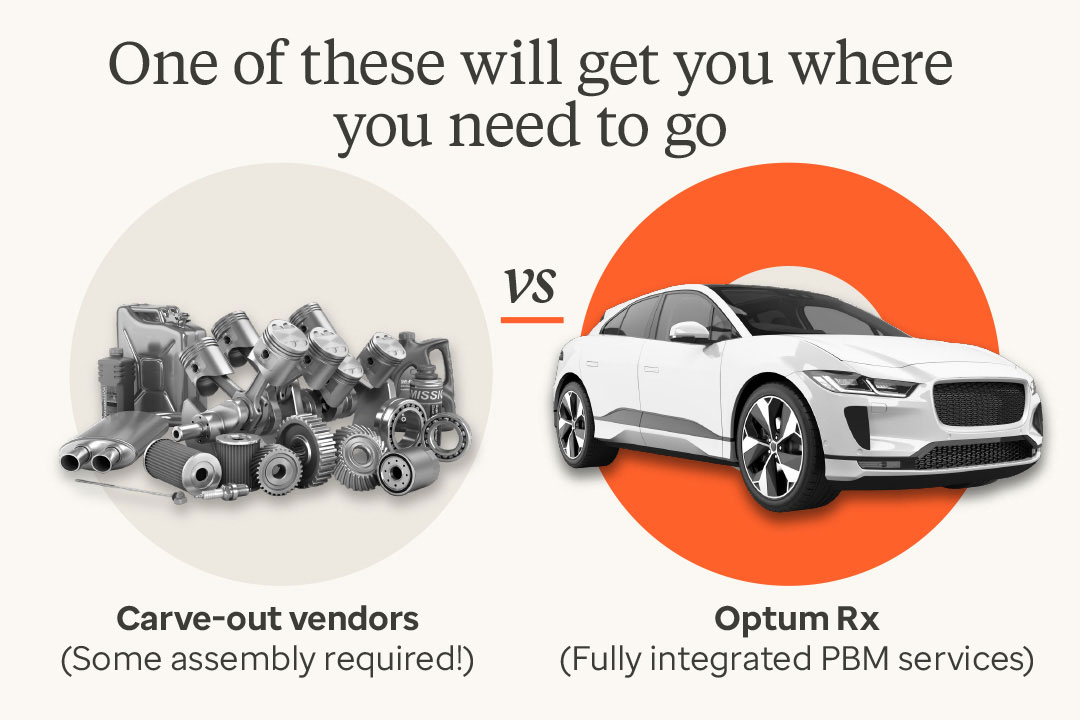

Carve-out vendors have stepped into this space, making big promises about cost savings.

What they don’t say is that by disassembling your pharmacy benefit plan, all you have left is a pile of unconnected parts. You are expected to put them together. This may yield some short-term savings, but only at the cost of disrupting the patient experience and undermining clinical care. That costs you time, effort and expense.

Our partnership with you focuses on 3 key areas:   

  1. Transparency. We provide clear, detailed, verifiable data at every step of the process. This includes empowering health care providers with the information they need to make informed decisions and prioritizing consumer protections to ensure all members are well-informed about their health care choices.
  2. Clinical expertise. Our team brings deep experience in clinical care and benefit management. We’re supported by the extensive resources of Optum, ensuring you have the best possible guidance.
  3. Better value. Our size and scale allow us to offer cost-effective solutions that ensure access for members. We’re committed to addressing your unique challenges and providing you with tailored choices to maximize access and affordability.

What are the types of specialty carve-outs?

The specialty alternatives plan sponsors are considering vary in scope and detail, but what they all share is separating elements of specialty pharmacy from the PBM. This may take the form of excluding certain drugs from the formulary, or even removing specialty pharmacy altogether. 

Specialty carve-out vendors offer various drug management services, often promising significant savings over a PBM. These vendors can take many different forms, including these main types:

Utilization management (UM) and prior authorization (PA) carve-out 

These vendors claim to provide tighter management of UM and PA by separating these services from the PBM. They argue that this will better align incentives and remove potential conflicts of interest around which drugs to approve.

Coupon maximizers 

These vendors aggressively maximize coupon assistance from manufacturers to reduce plan sponsor-paid costs.

Alternative-funding vendors 

These work by removing specialty medication coverage from the plan, then rerouting patients to alternative funding mechanisms, such as patient assistance and foundation funding.

Carve-out specialty pharmacy 

A client may choose not to use Optum® Specialty Pharmacy and instead contract for specialty dispensing exclusively with another specialty pharmacy.

Standalone specialty drug management 

These solutions take over all PBM services for specialty medications. They often claim “cross-benefit” capabilities and may offer additional services in areas like oncology.

Carve-out myth #1: Plan sponsors can better manage utilization with a specialty carve-out

Specialty carve-out vendors claim to provide tighter utilization management of specialty medications by separating services from the PBM. They say this better aligns incentives and removes potential conflicts of interest between the PBM and its owned specialty pharmacies.

Our analysis of PA approval rates doesn’t support this. We compared PA approval rates for patients who filled exclusively through Optum Specialty Pharmacy versus those who could go anywhere to fill their prescriptions. The analysis found no statistically significant difference in approval rates at any of the therapy class levels.2

Optum Rx has rigorous, independent clinical management processes. Our UM criteria are grounded in a robust, comprehensive library of criteria that are subject to clinical Pharmaceutical and Therapeutics Committee (P&T) process reviews. Plan sponsors who carve out to vendors who do not align to our UM standards will see an impact on their financial guarantees. 

We also maintain a rigid firewall between how these clinical policies are set and how they’re executed. Our UM offerings allow benefit sponsors the opportunity to select UM edits as they see fit to help control costs and manage member disruption.

In addition, Optum Rx offers multiple strategies delivered at the pharmacy counter to carefully dispense specialty medications. These ensure patients get the medications they need and adhere to therapy while reducing waste. Our strategies balance maintaining adherence with limiting oversupply by avoiding auto-refill programs and surplus edits. 

Our specialty medication management strategy aligns cost management strategies to deliver healthier outcomes and savings opportunities. Plan sponsors can lower their pharmacy spend by up to $16 per member per month (PMPM) with Optum specialty medication management.3

Our prescription optimization program proactively converts patients from higher-cost brand name specialty medications to lower-cost generics, which leads to estimated annual savings of $1.7B for payers and $25M for patients across our book of business.

Simultaneously, we help patients become more adherent — in excess of 90% adherence for patients taking oral oncology medications — which translates to $8.1M cost avoidance for payers.5

Carve-out myth #2: Patients receive equally good pharmacy care when specialty is carved out

Carve-out vendors claim they can offer the same clinical support a patient would receive with an integrated benefit. This clinical support plays out in aspects like sufficient access to therapy, managing drug-to-drug interactions and continuity of care.

The reality is the exact opposite. Specialty carve-out vendors will only be able to support some drug regimens. Drugs that are accessed through a carve-out do not benefit from drug-utilization reviews. These reviews are critical since most patients who take specialty drugs also take multiple other medications. Patients can also face significant risks of disruption to continuity of care.

Alternative funding sources are not a guarantee of coverage. Funding from coupon maximizers often runs out early in the calendar year, leaving patients without any coverage and often requiring them to halt therapy. These are just a few examples of where patients must navigate a confusing and tedious clinical process, winding up with a suboptimal or potentially dangerous outcome.

Better together puts patients first. Systematic end-to-end specialty drug management includes cost and clinical management from the point of prescribing, to dispensing, through first use and throughout treatment. At no point is the patient left alone with nowhere to turn. Nor do caregivers lack a complete picture of the patient. This strategy offers not only better value, but better care.

Our Clinical Management programs are a core value provided by the PBM. We offer patients a personalized approach to drug utilization reviews and safety checks that make it easy to avoid drug-to-drug interactions.

Our analysis has shown that integrated prior authorization with the patient’s full treatment history and PBM/pharmacy interactions means patients initiate therapy faster. Optum Specialty Pharmacy has an extensive national footprint to also provide clinical support. The pharmacy holds accreditations from nationally recognized bodies demonstrating our commitment to go beyond specialty pharmacy requirements. 

Currently we hold accreditation from Accreditation Commission for Health Care (ACHC), National Association of Boards of Pharmacy (NABP) and URAC.

A male patient wearing a hospital gown.


Meet Paul

Paul was recently diagnosed with rheumatoid arthritis (RA).* He also has diabetes. Paul's doctor prescribes a new RA prescription.

*Paul is a composite figure

Ongoing integrated pharmacy support

Better patient experience and lower overall costs.

Step 1:

Physician office

Automated tools streamline the prior authorization process by providing specific employee information and cost. Plan sponsors receive lower unit costs with PBM cost levers.

Step 2:

Medication delivery and support

A patient care coordinator processes the first fill for RA medication and connects Paul to a specialty pharmacist.
 

Paul receives a first fill and medication consult for this medication, including guidance on how to inject and potential drug-drug interactions and side effects.

Step 3:

Seamless support

Optum Rx variable copay solution seamlessly modifies the claim cost at the point of sale without requiring any benefit design modifications, reducing plan sponsor cost.
 

We synchronize all of Paul’s medications — both traditional and specialty — so it’s easier for him to adhere to his treatment.

Carve-out myth #3: Specialty carve-out vendors offer a seamless patient experience with white-glove support

The pitch made by carve-out vendors rests on a seamless experience that guides patients on their complex care journey. They market white-glove support that leads patients through onboarding processes and over the course of the benefit cycle.

In fact, carve-out only further fragments the patient experience. Imagine a patient who is served by both a PBM and a carve-out vendor. Their medications are in two different places — some with their PBM, some with the carve-out vendor. This fragmented service is disruptive for both affordability and access.

For example, alternate funding vendors draw from a finite pool of foundation or assistance program dollars. Available funds are often quickly exhausted, which affects those who truly need assistance. Moreover, patients with carve-out vendors are often forced to use a copay card. If they don’t sign up, they’re charged full out-of-pocket costs. Patient access can also be affected and plays out in slower time to therapy. Some medication claims may be rejected, and members must seek coverage from unrelated third parties. Each additional process step can potentially delay initiating treatment.

Optum specialty therapy management embraces a fully integrated approach at every step in a patient’s care journey. This approach yields:

  • Superior experience
  • Timely access
  • Better affordability

Optum Rx supports patients across all of their therapies. We automate the experience where appropriate, taking most of the administrative burden off of the patient. We communicate with patients through our pharmacy, one patient at a time. 

Trust and transparency across the continuum are vital to aligning our patient experience. Our ultimate goal is to drive affordability, value, simplicity and access and to align interests and accountability at every step of the medication journey.

Carve-out myth #4: Plan sponsors get better economic value with a specialty carve-out

Specialty carve-out vendors, and particularly coupon maximizers, claim to deliver significant value by reducing specialty drug spend. But plan sponsors must consider the full financial impact when deciding whether to carve out to a third party.

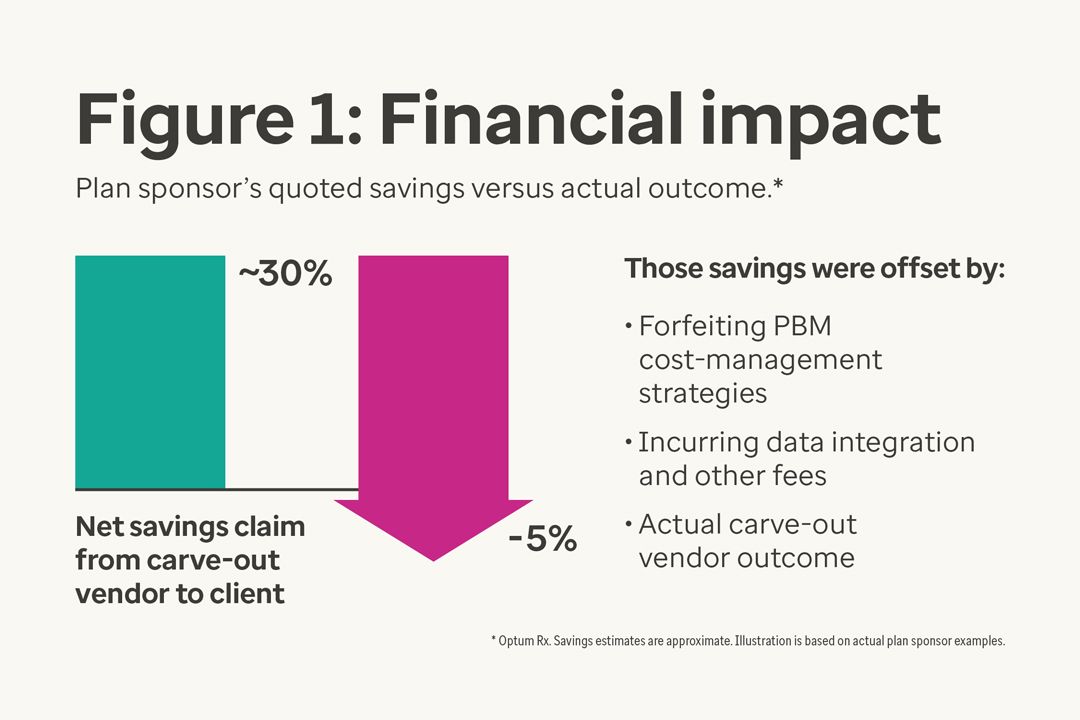
The reality is that quoted savings from these vendors do not include a “fully loaded” set of costs. Additional costs include fees and payments for the coupon maximizer services, lost benefit from PBM cost-management levers and other integration/data exchange fees. Figure 1 shows the impact of these additional costs against the quoted savings from these vendors.

Plan sponsors who carve out may also actually pay more for specialty medications over the course of the year. For example, when third-party funding sources run out, coupon maximizer contracts stipulate that the specialty medication coverage must be carved back into the PBM benefit. The plan sponsor would then be without the benefit of PBM cost management levers, which were forfeited at the time of carve-out.

We give plan sponsors the insights, guidance and flexible offerings that meet their needs. This includes building a strong clinical foundation and approach, which drives the lowest net cost. It also includes eliminating waste and neutralizing abusive pricing tactics by pharmaceutical manufacturers. We bring wide-ranging solutions and a holistic approach to the major cost drivers of both specialty drugs and complex cases.

This figure demonstrates a plan sponsor’s quoted savings versus actual outcome.

We personalize care for each member and bring price transparency, simple guidance and care into everything we do, from diagnosis to ongoing care.

One particular example of how we help with affordability is the variable copay solution, which balances cost savings with member needs. Our approach ensures that the member cost share is never greater than standard specialty tier copay, yet still maximizes available manufacturer dollars to reduce plan sponsor costs.

Our variable copay solution covers nearly 200 medications, which allows us to capture over 90% of available manufacturer dollars on top-used medications. Factoring program fees, the variable copay solution net savings is on par with the net savings of coupon maximizer programs, considering fully loaded costs. In 2024, our plan sponsors saw an average of $650 specialty drug cost savings per affected prescription.7

Be diligent when working with carve-out vendors

Plan sponsors must be diligent when working with carve-out vendors to ensure they’re not just optimizing one dimension across the specialty management continuum. There is no silver bullet that will meet the challenge of high-cost specialty therapies and the conditions they treat.

Plan sponsors need a broad, flexible portfolio of strategies. These strategies must properly account for all of the risks that accompany this level of complexity:  economic, clinical, member satisfaction, and not least, your reputation.

Coping with such a complex suite of challenges cannot be done piecemeal. It requires an experienced partner with an equally broad, flexible and far-reaching portfolio of solutions. Optum Rx delivers integrated solutions that work together in concert to deliver value for plan sponsors, providers and patients.

Related healthcare insights

View all
Addressing Pharmacy Issues That Matter to You

On-demand webinar

Addressing pharmacy issues that matter to you

From specialty pharmacy to drug affordability, our experts tackle your biggest pharmacy challenges.

3 Ways to Deal with Escalating Drug Costs

Article

3 ways to deal with escalating drug costs

Explore innovations custom built for today’s specialty challenges.

Alternative Funding: Real Savings or Real Problems?

Article

Alternative funding: Real savings or problems?

See how much "free" drugs will actually cost you.

Originally published on March 30, 2021.

  1. PCMA. Reminder: Employers Value PBMs. Published February 4, 2025. Accessed December 10, 2025.
  2. Optum Rx Analysis. February 2021.
  3. Specialty savings book of business April 2021 on a standalone basis, not tied to the medical carrier.
  4. Optum Specialty Pharmacy BOB Data 7/1/2021 – 8/24/2022.
  5. Optum Specialty Pharmacy oral oncology PDC. 1/1/2022-12/31/2022.
  6. Optum Rx. Savings estimates are approximate. Illustration is based on actual plan sponsor examples.
  7. Optum Rx Analysis Power of BI Report – 2024 plan year