
On-demand webinar
Reimagining behavioral health: Smarter solutions for modern plans
Join speakers Lou Dierking and Miranda Anderson as they share insights into how technology can drive much-needed improvements in behavioral health care.

Reimagining Behavioral Health
Hello and welcome to today's webinar, Reimagining Behavioral Health, Smarter Solutions for Modern Plans. Before we get started, I'd like to review a few housekeeping details. Today's webinar is being recorded and an online archive of today's event will be available within one to two business days. If you have trouble seeing the slides at any time during the presentation, please press F5 to refresh your screen on a PC or Command-R if you're using a Mac. You may ask a question at any time during the presentation by typing your question into the Q&A box located on the right side of your screen and pressing enter. And finally, I'd like to remind you of AHIP's antitrust statement located in the link just below the slide viewer. We will, as always, comply with that statement. Among other things, the antitrust statement prohibits us from discussing competitively sensitive information. We're very fortunate to have with us today Lou Dierking, Licensed Psychologist and Senior Vice President of Optum Whole Health Solutions, and Miranda Anderson, Director of Optum Advisory Services. At this time, I'd like to turn the floor over to our speakers. Welcome. Thanks so much. I really appreciate your introduction, and for all of you joining us today, thanks for taking the time to talk a little bit more with us about reimagining behavioral health. As previously noted, my name is Lou Deerking. I'm a senior vice president at Optum, and I'm a licensed psychologist by background. And I've had the pleasure of servicing health plans for the past 25 years and delivering innovative and important behavioral health solutions that really drive value. I am joined today by Miranda Anderson. Miranda, do you want to take a minute to just flesh out your bio a little bit? Absolutely. Thanks, Lou. I'm Miranda Anderson, and I work with Optum Advisory. We're the secret sauce behind many of the solutions from technology to product across the entire health system. I have experience doing both product digital and experience strategy for the past 20 years across health from pharma to med device, and most recently emphasizing the work in payer. And I'm here today having conducted some recent research with behavioral health providers to help add that unique perspective to making the health system work better for everyone. Thanks, Lou. Great. I'm really looking forward to hearing more about that. So a quick rundown of what you can expect with this hour together. We're going to start by talking about the challenges we've seen and I'm sure most of you have experienced in the behavioral landscape. We're going to shift then to talking a little bit about what can we do about that? What are some of the solutions we are deploying into the market that we've developed, and how can we make those available to those of you who might be interested in partnership in a different way? So with no further ado, I am going to start by just reviewing the landscape in general terms. I want to start by doing some level setting, and I'm sure you've heard a lot about this, just to make sure that we're all on the same page. In a recent study conducted by the NIMH, over one in five United States adults has been identified as having some sort of a mental health condition. That's over 20% of adults in the United States. That's a lot of people. Based on our experience, one in eight emergency department visits involve some sort of a behavioral health or substance use presentation. It may not be the primary driver for the presentation to the emergency room, but it's definitely a part of the picture. Despite this prevalence, over a third of the United States population lives in an area where there's a shortage of mental health providers, and over half of adults experiencing mental health needs didn't receive services in the past year. For the first time ever, in 2024, we saw behavioral health visits for commercially insured individuals in the United States surpass primary care visits. Some consumers are receiving care, that's really good news, but a large number who need care are still struggling to find it. many of you have heard about the the surgeon general's report on youth mental health following the pandemic all signs point to escalating needs for mental health support for children and youth particularly in the areas of depression and anxiety as they try to provide support parents and other caregivers struggle to understand the right care with the right provider and often ignore their own needs in the process. To put a finer point on the needs of children and youth, let's drill down a little into what we're seeing related to those diagnosed with autism spectrum disorder. Nearly one in 44 children today are receiving a diagnosis of autism spectrum disorder. We're seeing this increase in prevalence over the years as diagnostic protocols become more refined and as awareness is increased. Although autism spectrum disorder occurs in all racial, ethnic, and socioeconomic groups, it impacts boys four times more than girls. The good news is that autism spectrum disorder can be diagnosed as early as 18 to 24 months. And with early intervention, we can see great improvement in a child's development. Early diagnosis and treatment can reduce the cost of lifelong care by two-thirds when compared to those who are not fortunate enough to receive this early help. Sadly, at this point, we still don't know what causes autism spectrum disorder. With needs escalating consistently, member expectations for care are also evolving and shifting. It's critical that plans think about how to understand and respond to those evolving expectations. by expanding access and speed to care by offering a broad spectrum of evidence-based programs and delivery modalities, things like evidence-based substance use programming that includes medication-assisted treatment or broad access options that encompass both face-to-face, virtual, and digital care, addressing specialized needs that go beyond the basics, considering level of need as options and presentation, thinking about things like the spectrum of need. Is there a low-intensity need that could be addressed with a very low self-service sort of tool? Or is there a higher need that may need to be addressed with a face-to-face intervention? And then incorporating quality and equity into network development and member selection. Investing in provider education focused on things like unconscious bias leads to more effective care, better outcomes, and stronger provider member satisfaction. Providers are the backbone of an effective network and of an effective behavioral health model. Understanding their unique needs is critical to retention and drive stronger collaboration. I'm going to turn the floor over to Miranda to speak about the work she's done recently to better understand behavioral providers and their experience. All right. Thank you so much, Lou. I love what you were just talking about in terms of the member experience as well, understanding what our patients and prospective patients are going through as they seek care and then ultimately, hopefully find it with a licensed behavioral care provider. Recently, our team had the opportunity to explore that provider side view, what they go through on an everyday basis and what their lived experience is, both as they navigate complex patient cases and as they work through working with payers. What we did is we researched in a qualitative manner, going deeply through a series of nearly two dozen providers practices, conducting complex, in-depth interviews and table talks with the providers and with their staff if they had them. and then doing a sort of lengthy study over six Weaks, making sure that the issues that we talked about over the table, if they were resolved, we were able to record that. And if the issues persisted, we were able to record that as well. So what we're going to do first is just put ourselves in the shoes of the behavioral provider. From a demographic perspective, most of the behavioral health providers in this country are soundly in middle age. They steer a little bit younger if we're looking at licensed family therapists or counselors or social workers and slightly older if we're looking at psychologists and psychiatrists. From a gender perspective, the vast majority are female identifying. Geographically, they are broadly distributed, but with those rural areas still largely underserved. And I think what's interesting here is we turn our attention to the psychographic elements of the behavioral health provider. They're highly empathetic people. Their profession feels personal to them. Many of them got started in behavioral health because of a personal lived experience within their family. And then they know their patients deeply. Most of them experience a longer duration of treatment, a greater frequency of visits, and then the nature of the care itself, right? What they're talking about is different than ND replacement. When we think about the provider and what they're up against in terms of balancing their time, patient care is almost always one-to-one, so they can't delegate the core of their work, right? This isn't something where someone else in the practice can operate at top of license and help cover the care it also makes it more difficult for them to scale volume and grow their practice if they're trying to grow what we're also seeing both qualitatively and quantitatively in the industry is an increase in small practices folks with only one to three providers and what it means is that there are no billing and claims specialists so all of the administrative labor falls upon the providers themselves. What we also see is that oftentimes these providers come with an established perception of what it is like to work within the boundaries of the payer ecosystem. So if they're used to doing things a certain way, they try to persist that behavior even though they're in a smaller practice. And so I love, Lou, that you were talking about the autism spectrum disorder, we had a number of folks from small and large practices who said they might delay the full workup for an autism diagnosis because it's challenging to get that prior authorization with some of the payers that they work with. Now, what I want you to take away from this slide and the one that follows, which compares the behavioral health provider from the traditional medical provider is this, behavioral health providers are less likely to work inside a large or sort of like institutionalized practice when compared with our traditional GPs. Also, when you think about that provider experience, oftentimes payers build their payer-provider relationship or payer-provider experience practice, kind of rooted in the idea of what it was like to work with GPs or even specialists. We expect that annual visit. We expect maybe those acute instances where someone shows up with an acute need, it's treated, and then they walk out the door. Behavioral care is dramatically, emphatically different, with a higher volume of frequent visits and session-based billing. Our EHR and admin tools are not built on the whole for behavioral providers. They're a bolt-on to what was originally built for a larger GP type practice. And last but not least, because of that, the intensity of the work that they do, the fact that it's ongoing for Weaks and months, our behavioral providers are at much greater risk of burnout individually. So just as you think about provider experience, think about the fact that it's dramatically different than a GP who sees their patients more like once a year. Now, because of that, let's think about the burden, that administrative labor that comes with a behavioral provider's lived experience. Like I said previously, the providers see their clients at a much higher recurring rate. That's something you're probably already familiar with. But when you think about that higher recurrent rate, think about the cascading effect on claims. If there's an issue with a claim submission the first time, chances are the behavioral provider makes that same mistake three to six times before it's caught, and they're able to rectify the situation. In a small provider practice, where they're reliant on those weekly sessions to drive revenue, being behind on payments can become a financial stressor for them as well. That administrative labor is particularly burdensome for the small practices. We already know that folks spend 15 to 20 percent of their time on administrative tasks, whether it's keeping their clinical records up to date or submitting claims and dealing with PA, just think about that burden being exacerbated in the small practices where, in effect, it becomes non-billable night and weekend work. Last but not least, despite some gains in the past decade to improve the quality of PA, behavioral health is still more likely to have prior authorization associated with it than analogous medical services. So anything we can do as payers in that space This will help make their experience better and get patients the care that they need. Just some final stats to close us out here. As payers, I think we often think we're working diligently to improve the provider's experience. But most behavioral providers who do work within the bounds of insurance, if they take insurance, they work with 15 payers on average. So that means that every administrative burden that they have to work to solve, they have to work to solve differently depending on the payers they work with. Several of the administrative staff that we talked to basically mentioned, oops, I'm going to move back, basically mentioned that it's almost like playing a game where the rules are different for every payer and they simply have to memorize them or create their own personal cheat sheet so that they understand how to get paperwork through a particular payer set. So as we're thinking about that provider experience, that's one of the things we'll want to just keep in context. So just the last few elements here that we would suggest that payers work through to continue to make the provider experience and therefore the patient experience barrier. think about those behavioral providers being deeply relational. There's an element of distrust in the system just due to decades worth of perceived lack of respect and disparity between behavioral and physical health. They have more claims per patient than the typical GP. The administrative burden weighs heavy on them and every hour that they spend doing billing and payment and administrative labor is an hour they're not spending with patients delivering care. And then last but not least, they are willing to self-serve. If we as payers give them opportunities to find information themselves through great transparency, whether it's a web portal or an IVR or an AI assistant, they're willing to use it as long as they can guarantee that the information is accurate and then they're not going to have to call three places in order to make sure that their patient is in fact eligible for coverage so these are just a few of the things we're thinking about in terms of provider experience but don't worry we didn't leave you out payers i'm going to turn this back over to lou and she's going to cover what the payer experience is like and some of the issues that are being exacerbated by lack of access and and mental health parity. Take it over, Lou. Great. Thanks so much, Miranda. Having been a care delivery provider in a previous life, I can attest to all of what you're talking about. It's really important work that you've done. So thank you for raising the perspective of the behavioral provider in such a really great way. So far, you've heard us talk about the general behavioral landscape through the lens of the consumer and through the provider. I want to spend a minute just talking about the lens of the health plan itself. What's your experience like? To start, it's hard. It's hard to be a health plan in today's environment. There are pressures to control the administrative and the claims costs while utilization trends continue to rise. Access to high-quality, affordable care is an ongoing concern. The regulatory environment is becoming more and more aggressive, with frequent changes that are difficult to keep up with and often drive a negative financial impact. And your choices for comprehensive behavioral health partners are shrinking while the market is flooded with niche startups toting hard-to-believe value and impact. When you combine these headwinds with those we've discussed to this point, you've got quite a bundle of challenges to overcome in trying to provide the best behavioral service to your enrolled members. So what can we do about it? I'm really glad you asked. We're going to spend a minute now and maybe a few more than one, just talking about a little more in terms of how Optum has thought about these various challenges. We've scanned the landscape, and we've been thinking about solutions in four specific categories of focus. We're looking at integration, we're looking at ease of access, we're looking at flexibility, and we're looking at value. We've considered the various challenges as we've talked about them so far today, and we've talked about and are really creating solutions that we believe address those challenges with strong, performing, innovative options that health plans can adopt and offer in all markets. I want to go deeper in the coming slides to talk about each of these ideas separately so you can see how we're thinking about these various solutions and you can hear more about what we've been up to. So we'll start with integration. Integration means a lot of things to a lot of people. You ask five different people and you're probably going to get five different definitions of what immigration means. When we think about it, one of the primary things we think about is how we, as a behavioral partner, become a seamless extension of the health plan. This means that member needs are addressed through a whole-person lens, where we consider comprehensive needs in each interaction, both the physical and the behavioral and the social determinants, all as part of a whole-person intervention. These considerations lead to more well-informed connections to the right care. Providers have access to fully integrated data that allows them to understand and close gaps in care as well, as they're seeing members in their own practices. Primary care practices, where a number of members get their first taste of behavioral care, and sometimes that's where they get all of their medication management done, those practices can be enabled to extend their practice through embedded behavioral capabilities that allow them to retain and better treat that member holistically. Those same practices have access to embedded training and behavioral health tools that round out their knowledge and understanding of behavioral needs. It allows them to increase their in-office effectiveness and to retain patients. Plans can leverage similar fully integrated data to identify and effectively manage trends. They benefit from experienced go-to-market and growth support, and ultimately, they recognize greater total cost-of-care savings. Some specific examples of how we partner to seamlessly deliver care include integrated care coordination processes across medical and behavioral case management that support members with comorbidities and develop whole-person plans. Self-service dashboards that allow reporting in real time for health plan access to your own data for in-the-moment awareness. I'm really proud of that particular capability because I think it differentiates us, and it really has responded to some of our health plan feedback where they want a little more flexibility themselves in manipulating their data. We're offering that in a real-time online access sort of view that has been really well received. We've also seen great success in supporting our plans through RFP and go-to-market support for key growth opportunities. The plans we've partnered with have consistently seen success in expanding their market share and introducing new lines of business. Through our data-informed partnership, we've seen meaningful impact to total cost of care for members experiencing a combination of depression and physical health situations, as well as comorbid depression and substance use disorder. We believe that partnering seamlessly with the health plan delivers a better member experience and stronger outcomes, and we're seeing those results play out. we think about ease of access, we talked earlier about access increases, and we really started seeing that spike at least 10 years ago. When COVID hit, we saw a new and equally challenging dynamic around access. We were all supposed to stay home, but individuals in care still needed support. Optum has consistently taken a three-pronged approach to increasing access and member choice by building in-person, virtual, and digital capabilities simultaneously. Because we approached access in this way, members covered through Optum behavioral network saw uninterrupted care through and following the pandemic. Like many of you, we saw our virtual access spike during the pandemic, where over 90% of outpatient therapy was delivered virtually. We saw that spike sustained for probably two or three years, and recently we're starting to see that settle into a more stable average, where 2024 saw just shy of 57% of visits delivered virtually. We believe that's probably the new normal as we go forward, thinking about various service delivery modalities and the need for convenience. We'll spend a little more time talking about not just access in general, but how do we make it easier for members to actually find care? Our online navigation tool guides members to care based on a brief survey of needs and considering the various access preferences that are available and that are aligned with the members' expectations. Our directory offers not only service delivery options like face-to-face, virtual and digital, but also takes into consideration the health equity and cultural sensitivities, enabling provider searches to truly be personalized to a member's unique needs. Our member portal supports consumers in increasing health literacy and preparing themselves for therapy through numerous videos and other materials available in a self-service environment. it. I'm really proud of the work that one of our medical directors has done in terms of producing some really wonderful videos that explain things like the difference between various provider types and the reasons you might pursue various different provider types like social workers versus PhDs versus MDs, and also explaining the differences between actually in preparing a member for their first therapy experience, really helping them understand what to prepare for, how to think about their own needs as they go into that therapy experience, and reducing some of the anxiety that might be associated with engaging in therapy. Our network is available nationwide and contains all provider types, including specialty providers like ABA and medication-assisted treatment. And many of our outpatient providers participate in online scheduling for a one-click experience for members. What that means is that members are able to identify the providers they're interested in, find their available appointments, and schedule those appointments all within the member portal. They're then able to go back and access that appointment through that same member portal, containing that experience into a single space. Using that capability creates a time to appointment in just under five days. You heard Miranda talk about behavioral health providers and their challenges, and we've spent a lot of time thinking about how to make the provider experience better and easier. We know they're the backbone of our network, and their satisfaction is critical to access. So our value-based payment programs were developed in collaboration with our provider base, assuring that we were thinking through what would be some of the most realistic metrics and outcomes, and the most meaningful rewards for our providers who participate. We've invested in a number of automation innovations that reduce the administrative burden you heard Miranda talk about by automating otherwise human-based tasks, things like prior authorization or benefit and eligibility lookups, demographic changes, claims tracking, and all sorts of other types of things of administrative tracking that our providers are needing to do. All of these activities are now automated for increased efficiency and provider satisfaction. Through a partnership with Optum, plans are able to benefit from the same access and automation investments that benefit members and providers. We leverage our broad footprint to support plans as they grow and expand into new markets, acquire new clients, and offer new products. Our access innovations also serve to differentiate health plans as they compete to retain and grow. Finally, our value-based care arrangements not only benefit members through improved care and providers through rewards for performance, but they are key to our affordability strategy, where plans can recognize true savings. Optum thinks about access across many acuity levels, as well as personas seeking care. As we think about this broad spectrum of care, I want to take just a minute to talk about market disruptors, those who are offering the newest, shiniest object with the out-of-this-world value. I know health plans are bombarded with these innovators on a daily basis. Some of them are real, while others are just not what they say they are. Trying to differentiate between the two requires time and resources, two things health plans never have enough of. In partnership with Optum, one of the things we've been doing for years is conducting that analysis. We have reviewed hundreds of innovative partners, and we've looked for the best value, the strongest outcomes, and a solid business model that we believe has longevity. When we believe we've found the cream of the crop, we develop strategic partnerships that we introduce to our partner plans. You benefit from our work. A great example of this is the strategic partnership we formed with Calm Health. I'm sure many of you are familiar with Calm. I have not accessed it myself, but I hear that the bedtime stories are pretty amazing. Calm Health is a plan-oriented version of Calm that introduces broader capabilities and allows for off-ramps to identify an available benefit or other programs as identified through ongoing in-app surveys. It's a great way for members to get introduced to the idea of behavioral health support and then to provide recommendations for further programming that's available through the plan that members may not be as aware of. This partnership is new to health plans in 2026 and is designed to engage consumers who find themselves on the lower severity end of the spectrum. They might need a boost or some support of some sort, but they're just not sure what it might be, or it feels like therapy might be overkill. By engaging these consumers at this early stage, we can also address emerging needs quickly and maintain a quality of life that's less likely to deteriorate. Rather than applying a one-size-fits-all approach to our health plan relationships, we work with our partners to build a behavioral health solution that best supports members and addresses your priorities and goals. We're here for members when they need us, offering a wide variety of supports that you've already heard me talk about, things like self-guided experiences from Calm Health to more traditional forms of treatment across all levels of care, making sure that those services, and recommendations are personalized to the members' needs and expectations and that they're available through multiple modalities that create convenience. Our case management approach is also specialized based on members' unique needs and conditions, maybe things like autism spectrum disorder or substance use disorder or youth and families, and understanding the challenges that extend beyond just their behavioral health needs. We are intentional about considering the whole person, identifying barriers to care, as well as identifying achievable goals that align to the member's priorities. To be the best partner for our providers, we continually enhance the administrative systems and tools they use, including self-service automation through our provider portal and next-generation technology that drives our authorization process. You've already heard me talk a little bit about that. I would love to talk more about that in detail if anyone's interested. It's a really exciting area for us. We also support providers across the value-based spectrum with starting at nothing and moving to full capitation. We meet providers where they are aligned to their current capabilities and help them advance toward quality-based care. In fact, we're just finishing a measurement-based informed care pilot where we've been working with providers to collect outcome data that we're now analyzing to glean insights and inform next steps for both clinical programming and value-based opportunities. Plans look to us to use our broad expertise to understand their areas of opportunity and identify where our solutions can best help you build your behavioral health program. We've demonstrated experience enabling business growth, and we evolve and innovate with changing trends. Through years of partnership with health plans, we've developed more modular capabilities that respond to a plan's need for support in targeted areas of behavioral administration, and we've worked with plans to problem solve around issues that arise during the relationship. The example you see on your screen is a really cool example that reflects how we've collaborated to identify a smoother referral process for members being managed through a medical admission who require substance use treatment on discharge. Before our collaboration, these members would have been on their own to get from detox to their next substance use disorder level of care, and a lot of them got lost along the way. Instead of getting to that next level, they went back out into the community, did not receive the care that was recommended, and wound up back in an emergency room or back in another detox admission, what we did is worked with our plan to tighten the link between transitions. We offered stronger support to members as they were preparing to discharge from that medical admission, and we partnered with those medical case managers to kind of hold hands and assure that together we would see that member successfully transition into treatment instead of back into a community without support. With Optum flexibility, we're excited and capable to work specifically on the challenges that any health plan organization faces and work collaboratively to create a solution to mutually impact the lives we serve together. Here's a real-life example. So this is a reflection of the value that we bring, so the fourth pillar of how we think about solving the challenges we've been talking about. Members, again, members providers plan, members who engage in our personalized case management program, demonstrate lower inpatient admissions and all-cause ER visits, higher outpatient engagement, and better medication adherence. one of the biggest drivers of total cost of care. Through robust discharge planning activities and our value-based contracts with facilities, we've been able to positively impact readmission rates and achieve increases in our HEDIS scores specific to follow-up after hospitalization, a really critical point for health plans as they look at their quality program. For our plan partners, we understand that the balance between providing clinically appropriate care and controlling cost is critical. Therefore, we focus our clinical expertise and interventions on connecting members to the right care at the right time. Our analysis shows that for members engaged in our case management programs who successfully complete the program, They experience lasting impact with nearly 43% seeing lower behavioral costs at both 6 and 12 months. Here's a real-life example that brings our partnership and the value to the plan to life in a meaningful way. What you see on the screen is an example of a plan that we've worked with for a number of years. Through this time together, we started to see high out-of-network spend that continued to creep up, mostly in the substance use space, but across the board, despite a fully adequate network. As we dug in, we realized the plan's out-of-network reimbursement methodology was creating significant exposure for them. We brought this insight to the plan with a recommendation for change and an analysis of potential savings to be recognized. After extended discussion, additional analysis, and some thoughtful planning, we were able to make the recommended change, and the results were immediate. We saw a 43% reduction in out-of-network spend and over $5 million in benefit expense savings through this one benefit plan change. While the impact here is material, the take-home for all of you is that when we partner with a plan, we're relentless in leveraging data to identify savings opportunities wherever they may be hiding. As a seamless extension of the plan, we take these problems personally. In final note, the landscape is full of challenges for consumers, providers, and health plans, and we've talked a lot about them. Behavioral health is a growing area of focus for health plans that requires expertise and a strategic approach to recognize value. Optum is leading the way to better behavioral health through an approach that includes integration, ease of access, flexibility, and meaningful value. We partner with you to transform healthcare by creating a simple, affordable, personalized, and connected health experience. I thank you for your time today and welcome your partnership in creating a healthier world, one insight, one connection, and one person at a time. With that, I'm going to open up for questions for myself or for Miranda. Are there questions from the field? Thank you so much. At this time, we are going to address some questions that have come in during the presentation. presentation. Again, to ask a question, go ahead and put your question in the Q&A box located on the right side of your screen. And we have a couple of questions that have come in. I'll start with the first one. This particular health plan struggles with diabetes and metabolic disorders at higher rates than their commercial peers. Through integration, we were able to see greater med adherence to behavioral medications, improve total cost of care, and quality outcomes for those metabolic patients. So what other examples do we have on those integrations and how can behavioral or medical integrate? That's a great question. I think about HEDIS measures where we see a lot of focus and there's a lot of accountability for health plans. I know that there is a HEDIS measure around metabolic measurement or monitoring. Another area where there is a special focus is on, I'm going to call out a couple of those, substance use disorder. When a member is first diagnosed with a substance use disorder, there are HEDIS requirements around both an initiation of care and then kind of a persistence in care. With one of the plans we work with, we've developed a partnership with the practices that own the plan and with some of our partners who specialize in substance use disorder. So that as those members are identified in a primary care practice, there is a direct referral route that's been created. So those primary practices can refer directly into a handful of network programs that have committed to retaining those members, getting them in quickly within 48 hours, and then retaining them to make sure that both of those HEDIS measures are met, while also making sure that those members continue in care in a way that can drive impact for them. That's just one of a number of examples. Another one would be around ADHD medications, where, again, we're looking at a quick engagement and then a longer-term persistence in care. And again, partnering with plans to identify where we're seeing members who've been diagnosed with ADHD and making sure that those providers are educated about the requirements for HEDIS measurements in terms of continued monitoring for those members. There are lots of examples of that. Depression is another one where if we see a member who's been receiving antidepressant medications through their primary care practice, but there is no evidence of behavioral health treatment, we know that evidence supports the combination of those two interventions. So again, we're working with data. We're working with our pharmacy partners and our medical partners to uncover those members and make sure we can engage those members in obtaining the necessary evidence-based behavioral care to round out their treatment and to make sure they're getting the full value of that intervention. Those are just a few of a lot of opportunities. Thank you. Another question has come in. And it reads, how does shifting from percent of billed charges to percent of CMS rates impact the overall patient liability? Boy, that's a really, really good question. And I think it depends a lot on how the plan identifies their out-of-network reimbursement, what levels they want to set those reimbursement methodologies at. But at the end of the day, I think it's a conundrum in a lot of states and in a lot of plans where the fact that a member is accessing out-of-network care sort of puts them, provides a level of accountability for them where regardless of what the reimbursement methodology is, there could be a risk for that member that they're on the hook for filling in the gap. And that's part of making sure that when a member is using out-of-network care, they are fully aware of what that means. That's where when we think about some of the tools that are available on our Live and Work Well member portal, we think about how we can educate our providers about, first of all, the value of using in-network providers, given the screening, the credentialing, the monitoring that we conduct, and the partnership we have with those providers, versus those out-of-network resources where they're fully entitled if they have an out-of-network benefit to use that, but there are just some quality levers we don't have available and some overall administrative levers we don't have available. So it does shift to a certain degree what that cost accountability is for a member, and that's where that member needs to be fully educated about their benefit. Miranda, would you add anything to that? I do have one thing to add. I love that you talked about educating the member because I do think that's where it starts and letting them know why the network matters and the work that we've done to make sure that they're getting that high-quality care. But one of the other things we discovered in doing provider research is sometimes the provider just hasn't had a chance to join the health plans network. So depending on your network design strategy, providing a path to become part of the network. So, for example, if they've been seeing this patient for five years and they move from one plan to the next based on their employer sponsorship, providing a path to join the network is a really healthy alternative to continuing to make sure that the member gets the care that they need from the provider that they have that established rapport with. So that's an awesome point. Yep. Thank you. Another question has come in. When managing out of network spend using a percent of CMS rates, is the license level differential applied or is it the physician rate used across the provider types? That again depends on the plan's structure for their out-of-network methodology. Again, being a seamless extension of the plan, we want to make sure that we are aligning our reimbursement methodologies as much as possible with the plans. So we take our lead from them and we're also consulting with them to make sure that if they're applying a license differential, like between an MD and a nurse, we're also applying those same differentials as we are as we're looking at our methodology. Thank you. And one more question has come in. What solutions have you seen be effective for serving both youth, children, and caregiver populations? Oh, I'm glad you asked that question. We've got a phenomenal program that we call Family Support Program, as one example. And in that program, what we do is we look at child and their caregivers as sort of a unit. We understand that there are needs that are specific to that child or youth, and we're making sure that that individual is getting the care they need through a provider who is specialized and experienced in delivering care for that age range. I was one of those providers at one point in my life, and I know that there's a special skill set required to treat children and youth. But we also think about the family. We look at the family as a unit, and we also look at what else is going on with the family, understanding that as caregivers, there may be a bigger picture navigation, health scape navigation that they need help with. There are lots of complicated places that caregivers need to go when they think about the comprehensive needs of their children and youth, especially autism and spectrum disorder, great example where there are physical health needs, there are behavioral health needs, and there are often other sorts of needs, educational needs and so forth. So in our family support program, we're also thinking about how we can bring expert case management services for the family to help those caregivers navigate some of those other areas more effectively while also helping them think about their own needs. Their needs cannot go unnoticed. You know, you think about put your own face mask on, your own oxygen on before you help your child. Same thing is true here. We need to make sure that those caregivers are taking care of themselves so that they are able to take care of their children and others in their families. So the program really looks across the entire family system at providing support for all of the members of that system holistically. Thank you. No more questions have come in, but I would like to turn it back to you both for your final thoughts. Miranda, what would you finish with? I would just say that this inflection point of the increased need for access, the increased expectation of our consumer around what their experience should be like, presents a huge opportunity for health plans to just really rise up and meet the need of the market. And that we're eager to support you along the way, whether that's helping with benefit design, network design, or helping to create a better experience for the providers that you already have. There's a lot of opportunity, and together we can continue to make the system work better. Awesome. I would second all of that, and I would add that we at Optum have given a lot of thought to how to help plans through a lot of the challenges we talked about this morning. I'm really eager to have conversations with any of you to talk in more detail about the things we've developed, the ways we see those solutions, meeting those needs of the health plan, and solving some of those problems. So don't hesitate. If there's anything we can do to provide you with further support or to think together about how to solve some of the really hard problems you're dealing with, we're available and ready to help. thank you for your time this morning thank you so much to our speakers and thank you for that great presentation and for sharing your thoughts and to our audience thank you for participating in today's webinar this concludes today's presentation thank you again and enjoy the rest of the day.
Related healthcare insights

E-book
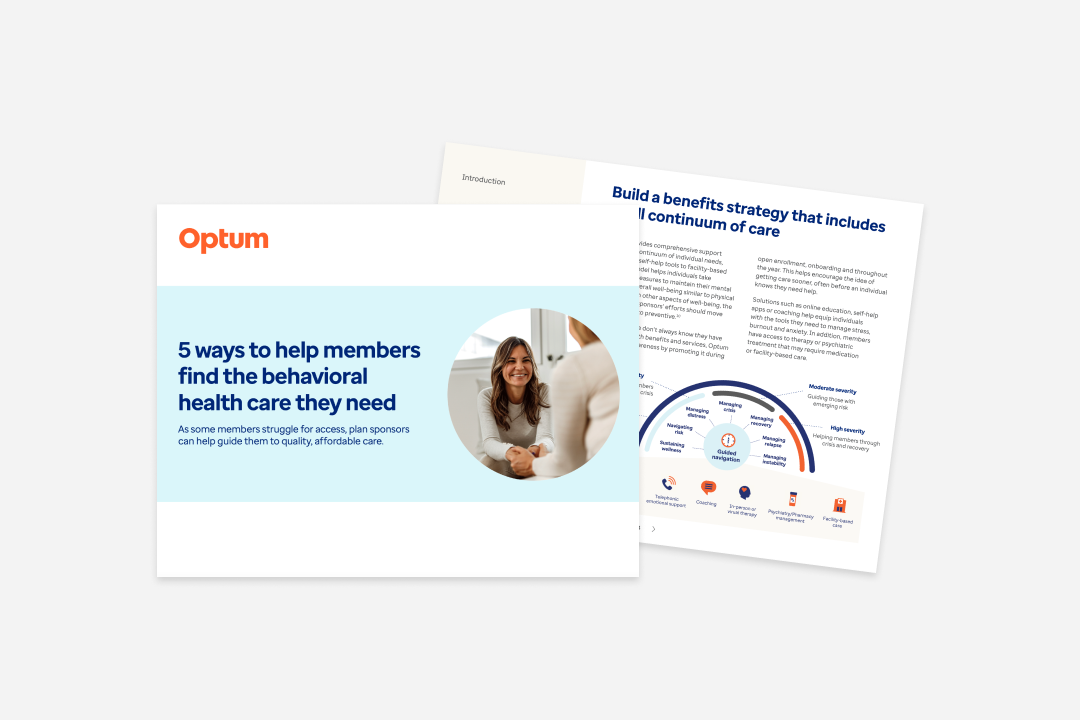
Guide members to quality, affordable behavioral health care.


Article
As GLP-1 use surges, payers and employers need to include behavioral support, deprescription planning and long-term care to sustain outcomes.

Article
The collision of chronic conditions and behavioral health challenges can’t always be stopped, but healthcare leaders can work to mitigate its impact.