[BACKGROUND MUSIC PLAYING]
[Text On Screen Ð Optum]
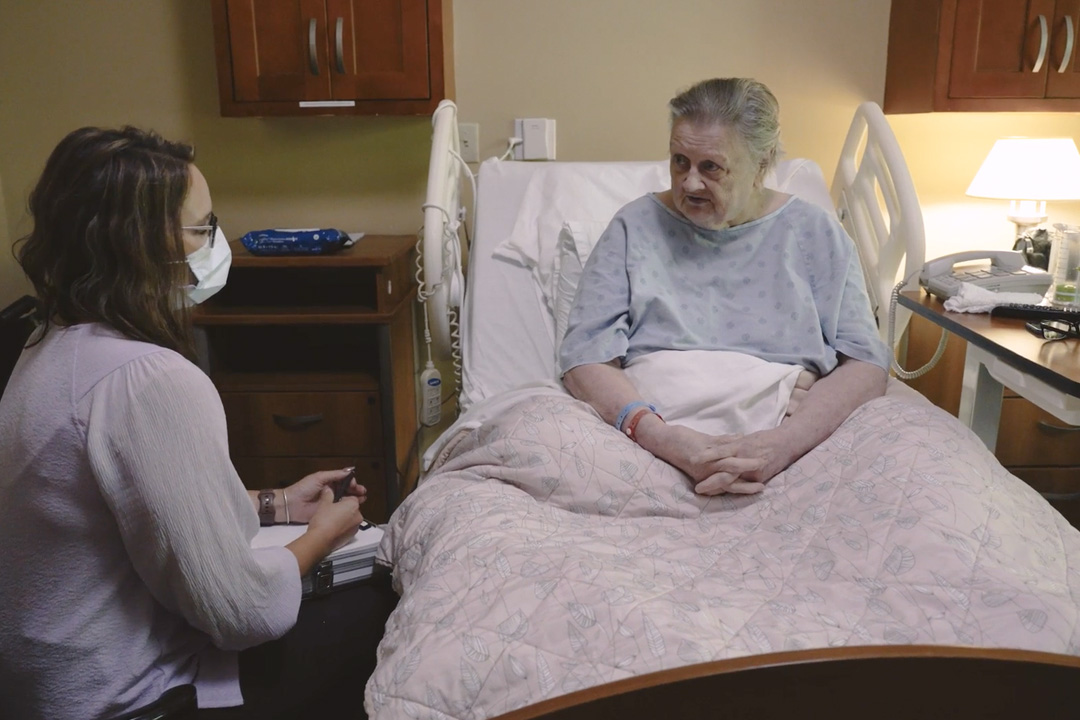
[VIDEO of Allyson visiting a patient in their room]
ALLYSON: Good morning. I'm Allyson. I'm your care coordinator. How's therapy going?
NANCY: Therapy's going well.
[ALLYSON P. SPEAKING ON SCREEN]
[Text On Screen Ð Allyson P., Optum Care Coordinator]
ALLYSON: My name's Allyson. I'm a care coordinator. I love what I do, I really do.
[VIDEO of Allyson walking and arriving at the Lutheran Home building]
When I tell people I'm a care coordinator, I tell them that I'm a physical therapist, by background, and that I'm going to help manage their care.
[VIDEO of Allyson talking to reception]
Do you know what room sheÕs in?
RECEPTIONIST: 1111
[VIDEO of Allyson visiting a patient in their room]
ALLYSON: And then I check in with them.
[VIDEO of Allyson speaking to a patient in his room]
Do you feel like you're on the right road to home?
RUSSELL: Today, I do.
[ALLYSON P. SPEAKING ON SCREEN]
ALLYSON: Kind of address anything they have first.
[VIDEO of Allyson looking at paperwork]
We discuss therapy, we discuss discharge planning. We talk about length of stay, anticipated length of stay, what their goals are.
[NANCY B. SPEAKING ON SCREEN]
[Text On Screen Ð Nancy B., Patient]
NANCY: Knowing that she is there, eases my mind and takes a load off of me, knowing that the questions will be answered, and answered correctly.
[ALLYSON P. SPEAKING ON SCREEN]
ALLYSON: It can be a very stressful time for patients, for families. They get a lot of information. There's been a lot of people that they've seen in the acute hospital. Now they're in a rehab setting.
[VIDEO of Allyson working in the hallway, then visiting with a patient in their room]
People are appreciative to have somebody to ask questions, to have a resource, to have a card and a phone number of somebody to contact later.
[RUSSEEL SPEAKING ON SCREEN]
[ALLYSON P. SPEAKING ON SCREEN]
RUSSELL: To have somebody actually writing things down, itÕs dynamite.
[VIDEO of Allyson walking through the building, in meetings]
ALLYSON: Being able to do that real-time, talk to a patient, and then immediately go and follow up with a provider right afterwards is a huge benefit, I think, to the patient.
[ALLYSON SPEAKING IN THE MEETING]
He was like, I'll cross that bridge when I get there. We talked through all the alternate plans.
[ALLYSON P. SPEAKING ON SCREEN]
It's an opportunity for everyone to collaborate together and make sure that the goals for the patient are in alignment with the facilityÕs and the patient's getting all the care that they need.
[VIDEO of the Lutheran Home facility, Allyson attending a meeting]
I've had a lot of families that have said I respect the decision or I don't agree with the decision, but I really appreciate that I was able to communicate and talk to somebody about this and I knew what was happening along the way.
[VIDEO of Allyson visiting a patient in their room]
Anything else for me?
RUSSELL: Keep doing a job that helps all of us.
ALLYSON: I will.
[VIDEO of Allyson walking through the building]
I think that knowledge is power, and at least they feel empowered knowing what's going to happen and knowing what they have control in, and somebody they feel comfortable helping with their care.
[Text On Screen Ð Optum]