Article

The GLP-1 revolution continues

New pills and expanded indications are poised to alter the dynamics of GLP-1 costs and treatments.

February 3, 2026 | 7-minute read

In this article

Over the past five years, the GLP‑1 treatment landscape has rapidly evolved. What was once a relatively small class of drugs has become one of the most significant drivers of pharmacy spend, transforming diabetes care and offering new treatment options to help address obesity. 

During 2024 and 2025, the GLP-1 class was increasingly defined by expanded use cases and approvals, with existing drugs gaining indications including cardiovascular risk, sleep apnea and kidney disease. 

The category is now entering a new phase as the arrival of oral options for weight loss and changing government policies look to shift use patterns and cost structures. For plan sponsors, understanding these dynamics is essential to safeguarding affordability while ensuring members receive high‑value care. 
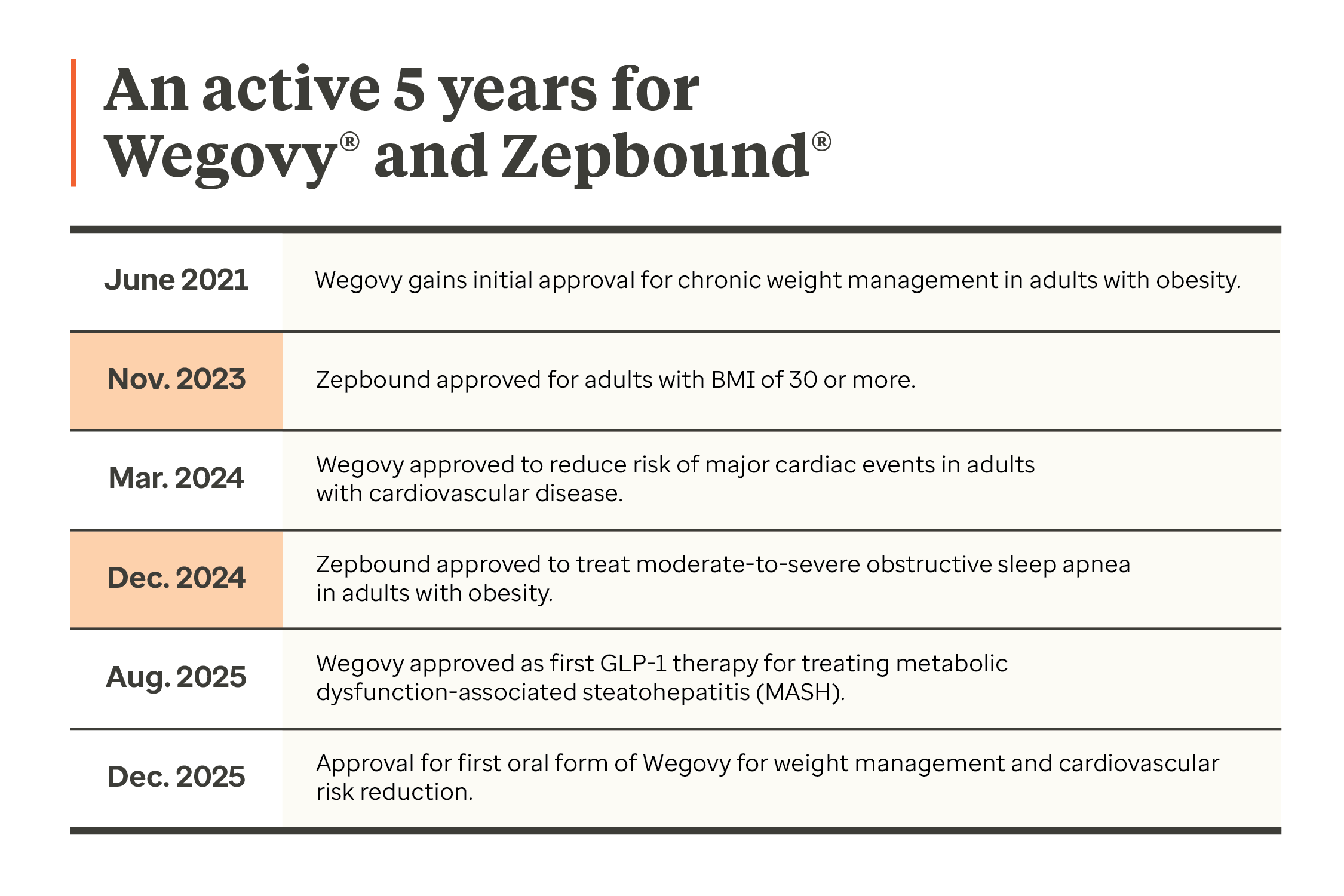
An active 5 years for Wegovy® and Zepbound®

Managing the cost of GLP-1 medications has always been complex. Despite sharing a chemical composition, two drugs can carry different names, indications and list prices. The speed of the development pipeline only adds to the challenge as GLP‑1 therapies are being studied for applications beyond diabetes and obesity, including heart, liver and renal disease.1 

With these evolving usage patterns, plan sponsors face a coverage dilemma defined by constant change and escalating financial exposure.

The arrival of oral GLP‑1 drugs

Now, a new inflection point is approaching as oral GLP‑1 medications designed for weight loss enter the market. In January 2026, a pill version of Wegovy (semaglutide) became available in the U.S after receiving FDA approval in December 2025. In theory, this approval opens the door for broader utilization of Wegovy by appealing to individuals who may be wary of injections.2 However, oral use of semaglutide comes with several practical considerations, for example, the pill must be taken in the morning on an empty stomach with water only. Additionally, users must wait a minimum of 30 minutes before eating, drinking or taking other medications. These requirements mirror those that may have limited adoption of Rybelsus, the oral semaglutide from Novo Nordisk approved for diabetes in 2019.3

One challenge in developing oral versions of semaglutide is that the drug is based on chains of amino acids known as peptides which are subject to degradation by enzymes in the stomach.4 In contrast, Eli Lilly’s upcoming oral GLP‑1 candidate, orforglipron, is a small‑molecule drug rather than a peptide, which could lessen the need for dosing requirements and offer greater convenience to users.5

This ease of use has fueled expectations of growing market share for oral GLP-1 formulations, with analysts estimating they could generate $22 billion annually by 2030, capturing 24% of the global weight loss market.6 For plan sponsors, the arrival of oral options means usage could grow, reinforcing the need for comprehensive utilization-management strategies.

More drugs on the way

While the arrival of oral GLP-1s for weight loss marks a milestone, the research pipeline remains active.  

Increasingly, drugs in this category are no longer defined by GLP‑1 activity alone and target multiple hormones. For example, tirzepatide, marketed as Mounjaro for diabetes and Zepbound for weight loss, is a dual agonist, combining GLP‑1 and GIP receptor activity. Drug makers are currently investigating triple receptor agonist therapies

Eli Lilly’s injectable drug retatrutide targets GLP-1, GIP and glucagon receptors. In a phase 3 trial, participants taking the highest dose of retatrutide lost an average of 28.7% of their body weight. The study also examined another potential indication for the drug, the alleviation of pain for individuals with knee osteoarthritis.7

Moreover, researchers are looking to target different hormonal pathways. A group of drugs known as amylin receptor agonists are currently advancing through clinical trials for obesity management. Early studies suggest these drugs may offer similar weight loss benefits while helping to preserve more lean mass, counterbalancing concerns about muscle loss seen with some GLP-1 therapies.

In December, Novo Nordisk filed for FDA approval of CagriSema, an injectable combination of GLP-1 and amylin analogues.8 As these therapies advance through the pipeline, they may complement or enhance current GLP‑1‑based strategies. As a result, plan sponsors should anticipate a larger and more segmented marketplace.

Government action adding additional pricing uncertainty

As new drugs and indications reshape the clinical landscape, policymakers are reshaping cost and coverage frameworks. In November, the White House outlined a three‑part strategy aimed at lowering GLP‑1 prices: 

  • Reinterpret statutory exclusions to allow Medicare Part D coverage of anti‑obesity medications for the first time. 
  • Require supplemental rebates from pharmaceutical manufacturers participating in the Medicaid Drug Rebate Program. 
  • Enable patients to access discounted prices through a new direct‑to‑consumer platform, TrumpRx.

As we noted in a recent GLP1-s white paper, the long‑term commercial implications of these actions remain unclear. However, the future impact of these policies combined with mounting competitive pressures may already be altering pricing dynamics. For example, Novo Nordisk launched its Wegovy pill at $149 per month via a direct-to-consumer model.9

For employers and health plans this volatility and shift in government pricing benchmarks may eventually cascade into future contract negotiations and formulary structures.

Optum Rx is your trusted guide through the GLP‑1 era

With a marketplace defined by complexity, rapid scientific progress and shifting policy, plan sponsors need expert guidance to help balance access, clinical integrity and financial sustainability. 

Optum Rx has built a comprehensive framework for GLP‑1 management that includes: 

  • Pipeline surveillance. We continuously monitor the GLP-1 drug pipeline to keep you aware of new drug launches, formulations and indications. 
  • Independent P&T review. Our independent Pharmacy and Therapeutics Committee ensures evidence-based reviews of new and existing GLP-1 medications to help inform formulary inclusion. 
  • Benefit and formulary strategy. Your Optum Rx partner can help you craft design changes and the utilization management structure necessary to help ensure appropriate use of GLP-1 drugs. 
  • Member support programs. Because clinical trial outcomes included diet and exercise, Optum Rx has made the Weight Engage program available, equipping members with the behavioral support, monitoring and motivation they need to get the most out of their medications. 
  • Precision analytics. Our leading data and analytics capabilities enable scenario‑based modeling to help plan sponsors anticipate cost impacts and make data‑driven decisions. 

A new wave of GLP‑1 medications is approaching. Optum Rx stands ready to help organizations futureproof their strategies, manage rising demand and maintain benefit affordability while delivering high‑quality care.

Related healthcare insights

View all
Unpacking Recent Federal Actions on GLP-1 Medications

White paper

Unpacking recent federal actions on GLP-1s

Evolving federal policy on popular weight loss medications introduces additional cost and coverage uncertainties.

GLP-1s: Real-Life Wonder Drugs?

Article

GLP-1s: Real-life wonder drugs?

Hundreds of clinical trials are vetting GLP-1s to treat everything from Alzheimer’s to arthritis. The question is: How will we afford it?

First Oral GLP-1 Drug for Weight Loss [Report]

Report

First oral GLP-1 drug for weight loss

Explore 3 new drugs for chronic conditions including obesity, severe asthma and hives (also known as urticaria).

  1. The Lancet.  The expanding role of GLP-1 receptor agonists: a narrative review of current evidence and future directions.  Published December 22, 2025. Accessed January 15, 2026
  2.  Cardiovascular Diabetology – Endocrinology Reports. From needles to pills: oral GLP-1 therapy enters the obesity arena. Published October 6, 2025. Accessed January 15, 2026
  3.  Pharma Voice. As weight loss booms, drugmakers look for an edge with oral options. Published May 28, 2025. Accessed January 15, 2026
  4.  Reviews in Endocrine and Metabolic Disorders. A new era for oral peptides: SNAC and the development of oral semaglutide for the treatment of type 2 diabetes. Published July 15, 2022. Accessed January 15, 2026
  5.  New England Journal of Medicine. Orforglipron, an Oral Small-Molecule GLP-1 Receptor Agonist for Obesity Treatment. Published September 16, 2022. Accessed January 15, 2026
  6.  CNBC. 2026 is the year of obesity pills from Novo Nordisk, Eli Lilly. Published January 10, 2026. Accessed January 15, 2026.
  7.  Eli Lilly.  Lilly's triple agonist, retatrutide, delivered weight loss of up to an average of 71.2 lbs along with substantial relief from osteoarthritis pain in first successful Phase 3 trial. Published December 11, 2025. Accessed January 15, 2026.
  8.  Novo Nordisk.  Novo Nordisk files for FDA approval of CagriSema, the first once-weekly combination of GLP‑1 and amylin analogues for weight management. Published December 18, 2025. Accessed January 15, 2026.
  9.  Novo Nordisk.  Novo Nordisk's Wegovy® pill, the first and only oral GLP-1 for weight loss in adults, now broadly available across America. Published December 18, 2025. Accessed January 15, 2026.


STATEMENT REGARDING FINANCIAL INFLUENCE:

This article is directed solely to its intended audience about important developments affecting the pharmacy benefits business. It is not intended to promote the use of any drug mentioned in the article and neither the author nor Optum Rx has accepted any form of compensation for the preparation or distribution of this article.