[SOFT MUSIC PLAYING]
[On-screen text – Optum Rx]
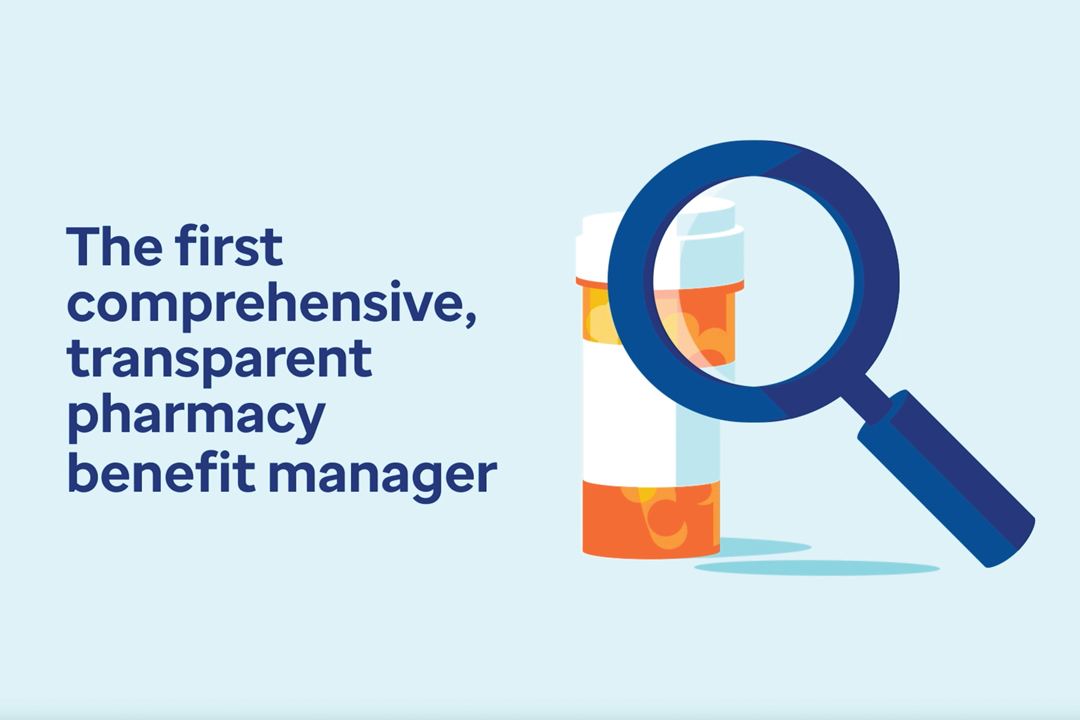
[Animation, a magnifying glass looking over a prescription medication bottle]
[On-screen text – The first comprehensive, transparent pharmacy benefit manager]
[MALE NARRATOR] Optum Rx® is proud to be the first comprehensive, transparent pharmacy benefit manager.
[Animation, a magnifying glass looking over a question mark]
[On-screen text – But what is transparency?]
But what is transparency?
[Animation, a magnifying glass looking over a coin]
Some equate transparency with just having visibility into what prescription drugs cost.
[Graphic, a coin and graphs and charts]
[On-screen text – We go much further]
We go much further, to promote transparency by giving you access to a wide variety of information well beyond drug pricing,
[Graphic, prescription medication bottles]
[On-screen text – How drugs are evaluated + How formulary decisions are made]
including how drugs are evaluated and how formulary decisions are made.
[Graphic, a magnifying glass over the words: “How we deliver transparency”]
[On-screen text – How we deliver transparency]
With Optum Rx®, you can expect simplified access to data
[Animation, two hands on a laptop with graphs, charts and data displayed on the screen]
[On-screen text – Contracting language, Fee structures, Pharmacy network changes]
such as contracting language, fee structures, and pharmacy network changes, the ability to drill down into data about individual drugs
[Graphics, pills, IV bag, syringe]
[On-screen text – Utilization factors]
and the factors impacting their utilization,
[Graphic, lines of data with dollar signs on each line]
[On-screen text – Auditing data]
and access to multiple types of data for auditing purposes.
[Animation, people looking over a wall of charts, graphs, and data]
[On-screen text – Tools and expertise]
We'll also furnish you with the tools and expertise to better interpret and make decisions grounded in data.
[Graphic, a magnifying glass over the words: “Transparent clinical decision”]
[On-screen text – Transparent clinical decisions]
Take, for example, clinical decisions.
[Graphics, pills, IV bag, prescription medicine]
One of the most important things for a plan sponsor to know is which drugs their members are taking.
[Animation, graphics of different pills scrolling across the screen]
[On-screen text – Independent Pharmacy and Therapeutics Committee (P&T)
As new drugs enter the market, they undergo a rigorous evidence-based review from our Independent Pharmacy and Therapeutics Committee, P&T.
[Graphic, a group of three people, one in scrubs, one in a lab coat, and two with clipboards]
Comprised of independent physicians, pharmacists, and clinicians,
[On-screen text – Relevant data + Scientific literature]
the P&T committee meets regularly to consider the relevant data and scientific literature for new and existing medications and their potential place in therapy.
[Graphic, a smartphone, folders and papers]
[On-screen text – P&T materials]
Optum Rx® clients are welcome to review P&T materials to get an inside look at our clinical deliberations.
[Graphic, a magnifying glass over the words: “Transparent formulary construction”]
[On-screen text – Transparent formulary construction]
Transparency is also vital to understanding how formularies are constructed.
[Graphic, a pill and a checkmark transitioning to an “x”]
Just because a drug is clinically appropriate doesn't necessarily mean it's right for your plan.
[Graphic, two people on clipboards, one with a lab coat]
[On-screen text – Clinical consultants + Formulary strategy advisors]
This is where our clinical consultants and formulary strategy advisors come in.
[Graphic, a person in scrubs and a lab coat writing on a clipboard, sitting within a smartphone, talking to another person sitting within a smartphone]
They will meet with you to review clinical recommendations and cost modeling to help you decide which medications best meet your unique needs.
[Graphic, a magnifying glass over the words: “Transparent pricing”]
[On-screen text – Transparent pricing]
Transparency is also paramount when deciding how you will pay for these medications.
[Animation, coins falling to land near a dollar bill and a credit card]
[On-screen text – Cost Made Clear, Several different payment options]
Our Costs Made Clear transparent pricing models offer several different payment options, each designed with transparency in mind.
[Graphic, a prescription medication bottle and a receipt]
[On-screen text – 100% pass-through models, Cost-plus models, Reference-based models]
These include 100% pass-through models, cost-plus models, and reference-based model options,
[Graphic, zoom in on the receipt]
[On-screen text – What we pay, What you pay, How you pay]
each of which clearly shows what we pay, what you pay, and how.
[Graphic, a magnifying glass over the words: “Visibility for providers and members”]
[On-screen text – Visibility for providers and members]
Yet plant sponsors are not the only stakeholders that benefit from transparency.
[Animation, a magnifying glass looking over a smartphone displaying an IV bag, syringe, and a pill]
[On-screen text – Access to information]
Members and care providers also need access to information to make better informed decisions.
[Animation, arrows between three graphics: prescription medication bottles, a checkmark, and a prescription medication box]
[On-screen text – PreCheck MyScript®]
Our real-time benefit check tool, PreCheck MyScript®, is embedded into a physician's existing prescribing workflow.
[Animation, a clinician navigating a tablet, with graphics of a price tag and a pill]
PreCheck MyScript® enables doctors to check current prescription coverage and price based on the member's benefit plan and find possible medication alternatives when appropriate.
[Graphic, a clock and a coin]
[On-screen text – Real-time pricing data]
Access to real-time pricing data also empowers members.
[Graphics, two medical cards, one with one dollar sign (Direct-to-consumer), one with two dollar signs (Insurance)]
[On-screen text – Price Edge comparison tool, Direct-to-consumer, Insurance]
Our Price Edge comparison tool compares direct-to-consumer prices with insurance pricing
[Animation, an arrow pointing down with coins falling into the arrow]
[On-screen text – Lowest available prescription drug price]
to ensure members always get the lowest available prescription drug price, covered or not.
[Graphic, a magnifying glass over the words: “A comprehensive approach”]
[On-screen text – A comprehensive approach]
Given the complexity of pharmacy benefits, we know a single tool or process cannot provide sufficient transparency.
[Animation, a magnifying glass hovering over three images: a group of clinicians, prescription medication bottles, money and a credit card]
That's why we will continue to advance our market-leading suite of transparency capabilities to deliver greater insight and accountability for you.
[On-screen text – Optum Rx®, Visit optum.com/clear]
Contact your Optum Rx® partner for more about our comprehensive approach to transparency.